

Cats don’t view their homes the way we do. While we see walls, rooms, and boundaries, cats experience their environment as a seamless, interconnected space. Their heightened senses - whiskers that detect air currents, sharp low-light vision, and a powerful sense of smell - allow them to move through their surroundings with ease and purpose.
Instead of assigning specific roles to spaces like we do (kitchen, bedroom, etc.), cats rely on sensory cues like airflow, light, and temperature to perceive their environment as a unified whole. Watching how they navigate can inspire us to see our homes differently, focusing on how spaces feel rather than how they’re defined. By slowing down and noticing these subtle connections, we can create a deeper connection with our surroundings - and perhaps even with our cats.
How Cats Perceive and Move Through Their Environment
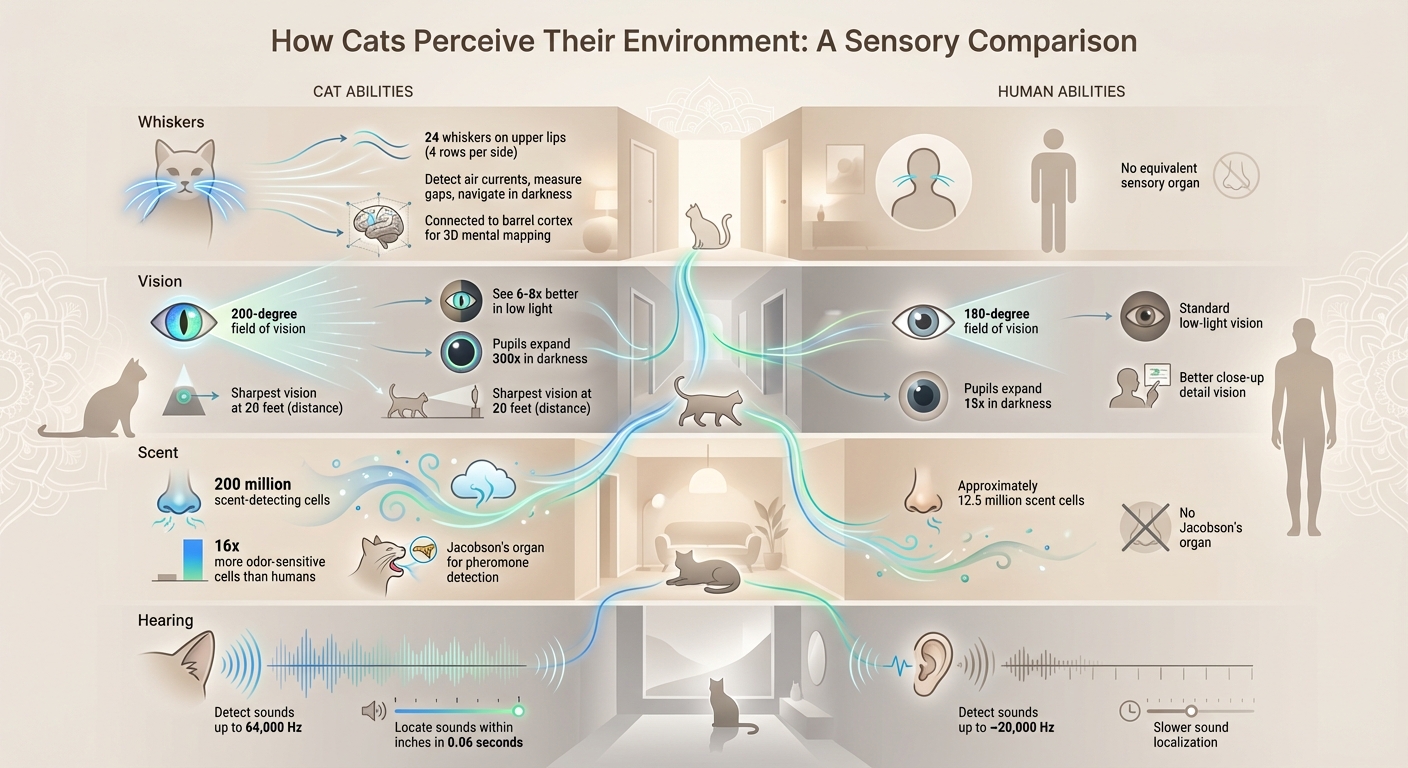
How Cats Perceive Their Environment: Sensory Abilities Compared to Humans
Cats rely on an intricate combination of senses to form a detailed and seamless mental map of their surroundings. Let’s take a closer look at how each sense contributes to their unique way of experiencing the world.
Whiskers: Air Detectives and Object Sensors
Cat whiskers, or vibrissae, are far more than just charming facial features. Most cats have around 24 whiskers on their upper lips, arranged in four rows on each side. These whiskers are thicker than normal fur and rooted deeply into the tissue, making them incredibly sensitive.
"Whiskers aren't just facial decoration - they're sophisticated sensory organs that detect air currents, measure gap widths, and help cats navigate in complete darkness." - Adam Gill, Cat Cognition
Using their whiskers, cats can sense subtle shifts in air currents and changes in air pressure, allowing them to detect the size, shape, and proximity of objects without direct contact. This information is processed by the brain’s barrel cortex, helping cats build a three-dimensional mental map of their environment. For instance, when approaching a tight space, a cat uses its whiskers to determine if it can squeeze through. During activities like hunting or close inspection, the whiskers fan forward into a "basket shape", offering precise feedback about objects too close for their eyes to focus on. This tactile input ensures that a cat perceives its surroundings as connected and continuous, even in the dark.
While whiskers provide tactile precision, their vision adds another layer to how they navigate their world.
Vision: A Panoramic and Low-Light Advantage
Cats have a 200-degree field of vision, slightly wider than the 180 degrees humans enjoy. This broad visual range allows them to detect movement from almost every angle, reinforcing their sense of the environment as a unified whole.
Their eyes are designed for low-light conditions, thanks to an abundance of rod cells and the reflective tapetum lucidum. These adaptations enable cats to see 6 to 8 times better than humans in dim light. Their pupils, capable of expanding up to 300 times in the dark (compared to a human’s 15-fold expansion), enhance their ability to navigate in near-total darkness. Interestingly, their sharpest vision is at a distance of about 20 feet, making them better at observing the overall layout of a space rather than focusing on fine, close-up details. This wide-angle, low-light vision ensures they experience their environment as a cohesive and continuous landscape.
But vision and whiskers are only part of the story - scent and touch play equally vital roles.
Scent and Touch: Mapping Their World
Scent is a cornerstone of how cats interpret their environment. With up to 16 times more odor-sensitive cells than humans, cats rely heavily on their sense of smell. The Jacobson's organ, located on the roof of their mouth, allows them to "taste-smell" pheromones and other chemical signals. When a cat curls its lip and appears to grimace - a behavior known as the flehmen response - it’s analyzing these scent molecules for social or territorial clues.
Touch also contributes significantly to their sensory map. Whiskers aren’t limited to their faces; they’re also found on the cheeks, chin, and even the backs of their front legs. These tactile tools help cats connect various parts of their environment into a single, fluid map.
Applying Cat Perception to Your Home
Taking inspiration from how cats interpret their surroundings, you can reimagine your home as a more harmonious and connected space.
Experience Your Home Beyond Labels
Try walking through your home without thinking of rooms as "kitchen" or "bedroom." Instead, focus on sensations - how the air moves, the way light shifts, or how warm or cool certain areas feel. Cats, with their incredible 200 million scent-detecting cells, experience their environment through sensory cues rather than predefined roles for spaces. You can embrace this perspective by identifying "comfort zones" based on factors like airflow, temperature, and light. Pay attention to where drafts come through, how sound behaves in different areas, or how textures change underfoot. These subtle transitions shape the experience of a space more naturally than walls and labels ever could. By tuning into these sensory markers, you can create a home that feels more fluid and connected - just as a cat would.
Arrange Furniture for Movement and Connection
Think about how furniture placement affects the way you move through your home. Cats, with their ability to locate sounds within inches in just 0.06 seconds and their sharp peripheral vision, thrive in environments that feel open and navigable. Arrange furniture to create clear pathways and unobstructed sightlines, which not only make spaces feel larger but also foster a sense of ease and security. Keep walkways free of clutter and use low-profile furniture to maintain a natural flow. Imagine how air and light travel through the space, and let that guide your layout. By focusing on movement rather than rigid design rules, you can create an environment that feels both practical and inviting.
Add Subtle Cat-Inspired Design Elements
Incorporate design details that echo a cat's natural instincts. Think vertical elements like floating shelves or changes in flooring to encourage upward and tactile exploration. Materials like untreated wood, cork, sisal, or stone can bring a sense of the outdoors inside, aligning with what designers often call biophilic design. These don’t need to be overtly "cat-themed" but can simply reflect a connection to nature and texture. Small changes like these invite you to engage with your home in a more mindful way, much like a cat does - fully present and attuned to its surroundings. By blending these elements into your space, you'll create a home that feels like an extension of your life, naturally balanced and alive with possibility.
Moving Through Space Like a Cat
Move Through Your Home with Intention
Cats have a way of gliding through spaces with a kind of quiet purpose, pausing often to take in their surroundings. When a cat enters a room, it doesn’t rush; it takes its time, sensing the subtle shifts in light, sound, and even the flow of air. You can bring this same deliberate awareness into how you move through your home. Instead of rushing from one room to the next, slow down and notice the details.
Take a moment to walk through your home without any particular goal in mind. Feel the coolness of the air near a window or the warmth radiating from a vent. Listen to how the sounds change as you step into different rooms. By focusing on these small sensory details, you shift your attention from simply getting somewhere to truly experiencing the space around you. This practice can help you feel more present, grounded, and connected to your environment.
When you move with this kind of awareness, your home begins to feel less like a series of separate rooms and more like one continuous, flowing space. Just as a cat seems to blend effortlessly into its surroundings, you can cultivate a sense of harmony in how you navigate your own.
Alternate Between Rest and Activity
Cats are masters of balancing energy. They alternate between bursts of activity - often during dawn and dusk - and long stretches of rest. This isn’t laziness; it’s an intentional rhythm that allows them to conserve energy while staying alert to their environment. Albert Einstein, known for his curious mind, once observed his cat, Tiger, during its still moments, using that quiet time as inspiration for his own reflection.
You can take a cue from this natural rhythm by syncing your most focused tasks with the transitions of light in your day - early morning or evening, when energy often feels more aligned. During quieter times, instead of reaching for your phone or filling the silence with distractions, pause and simply observe. Notice the way light shifts across a wall or the gentle hum of your home. These moments of stillness can become opportunities for reflection and mindfulness.
sbb-itb-b6c1dc0
What This Means: Connection Instead of Division
Drawing from how cats perceive their surroundings, this way of thinking can transform how you experience your home.
Rather than seeing your home as a collection of separate rooms with fixed purposes, imagine it as a single, interconnected space. Cats naturally sense this unity - they notice how air flows through doorways, how sounds echo between walls, and how scents weave invisible trails across the house. To them, these subtle connections matter more than physical boundaries.
This shift in perspective changes how you relate to your environment. Instead of moving from room to room with a checklist of tasks in mind, you begin to notice the sensory details that tie everything together. The way sunlight moves across the floor as the day progresses, the quiet hum of a refrigerator blending with the rustle of leaves outside, or the cooler air near a window - all these small details ground you in the present moment. They become familiar rhythms that help you feel more connected to your space.
Choosing connection over division means engaging with your home more intentionally. You start to notice how different areas affect your mood and energy. A sunny corner might lift your spirits, while a dim hallway could bring a sense of calm. Cats instinctively respond to these shifts, seeking out the spaces that align with how they feel or what they need. Their deliberate movements and restful pauses remind us to slow down and pay attention.
Conclusion: Seeing Space the Way Cats Do
Cats have an extraordinary way of weaving their surroundings into a seamless whole, reminding us that walls are just one way to define a space. While we see rooms divided by physical boundaries, cats experience a world shaped by air currents, scent trails, and sound frequencies far beyond our range - up to an astonishing 64,000 Hz, more than three times what humans can detect. Recognizing these subtle, invisible connections can transform how we perceive our own homes.
"Understanding cat perception means accepting that the world you see isn't the world your cat sees." - Adam Gill, Cat Cognition
This shift in perspective doesn’t require dramatic changes. It’s about tuning into the details that already exist - the way sunlight shifts across your floors during the day, how sounds echo from one room to another, or where cool air lingers near a window. These elements create a sensory map that ties your home together, much like the way your cat experiences it.
By adopting this mindset, you can move more attentively through your space. As noted earlier, paying attention to how different areas influence your mood and energy can help you respond to those subtle shifts instead of overlooking them. Cats, with their 200-degree peripheral vision, naturally take in multiple spaces at once. While we can’t replicate that biologically, we can expand our awareness, learning to see beyond the immediate task or room in front of us.
This isn’t about imitating a cat’s behavior but about embracing a broader, more mindful connection with your surroundings. When you stop viewing walls as rigid barriers and start sensing the links between spaces, you cultivate a deeper relationship with your home. Seeing your environment as an interconnected flow, much like cats do, invites a richer, more present experience - one that helps you feel truly grounded and at ease.
FAQs
Do cats understand rooms the way humans do?
Cats experience rooms in a way that's quite different from how humans do. They don’t think of spaces in terms of walls, doors, or designated purposes like we might. Instead, they rely heavily on their sharp senses - listening to sounds, picking up scents, and even feeling vibrations. This sensory-driven approach lets them move through their environment in a more seamless and connected way, paying attention to how areas flow together rather than focusing on rigid boundaries.
How can I make my home feel more connected for my cat?
Creating a home where your cat feels comfortable and engaged means paying attention to how they interact with their surroundings. Try to minimize physical barriers, giving them the freedom to move between rooms without restrictions. Add inviting nooks where they can curl up or quietly observe their environment. Incorporate elements that appeal to their natural instincts, such as open sightlines for surveying the space and different textures they can explore with their paws. By designing a space that encourages both curiosity and relaxation, you help your cat feel more at home and connected to their environment.
What are signs my cat feels stressed by the layout of my home?
Cats often show signs of stress when the layout of your home disrupts their sense of security. Behaviors like hiding, steering clear of specific areas, grooming excessively, or meowing more than usual can signal discomfort. Since cats depend heavily on their senses to navigate their surroundings, sudden changes - like rearranged furniture, altered lighting, or blocked pathways - can be unsettling. To ease their stress, consider designing a space that feels more open and aligns with their natural instincts. This can help them feel safer and more comfortable in their environment.


Leave a comment