

Cats bring a quiet, calming presence into our lives, connecting the spaces and people within a home in ways that often go unnoticed. Their graceful movements, gentle routines, and subtle gestures create a sense of balance and emotional connection. Whether they're resting in a sunny corner, purring softly beside you, or sitting at a threshold observing the world, cats remind us to slow down and appreciate the in-between moments of life.
They don’t demand attention but weave themselves into our routines, offering comfort through their presence. Research shows that most cats form secure attachments to their humans, relying on them for a sense of safety and calm. Their habits, like purring or silently following you, can reduce stress and foster a sense of peace in a household. Cats also teach us to live in the moment, letting go of unnecessary tension and finding joy in quiet companionship.
Through their understated influence, cats shape not just the physical spaces of a home but also the emotional atmosphere, reminding us that connection doesn’t have to be loud to be meaningful.
How Cats Move Through Physical Spaces
Living Between Spaces Without Claiming Them
Take a moment to notice how a cat moves around your home. It doesn’t settle into just one spot but seems to flow seamlessly from one area to the next.
This behavior goes beyond simple restlessness. While cats are undeniably territorial creatures, finding comfort in familiar surroundings, they also display an incredible knack for occupying spaces temporarily. Architect Britt Rozier describes this beautifully when reflecting on a cat’s fascination with thresholds:
It is the threshold that intrigues him. A space neither fully inside, nor completely outside. A dynamic fluffy gray area allowing the tail to be in one world and whiskers in another.
These in-between spaces - doorways, hallways, or even the edges of rooms - offer cats a unique vantage point. They can keep tabs on different areas simultaneously, existing in a way that feels both present and unattached. This effortless movement through thresholds highlights their ability to bridge physical divides while maintaining emotional connections. In many ways, it’s a quiet lesson in non-attachment: being somewhere fully without the need to claim or control it.
This graceful fluidity shapes not just how cats occupy space but also offers a quiet reminder about the value of living without clinging too tightly to any one place or moment.
What We Can Learn from How Cats Move
The way cats navigate their surroundings can inspire us to approach movement with more mindfulness and intention.
Every step a cat takes seems deliberate, as though it’s fully engaged in the act of moving. A cat doesn’t just travel from one point to another - it experiences the journey itself. Their movements reflect a kind of mindfulness that feels second nature.
Unlike humans, who often multitask or let their minds wander while moving through spaces, cats rely on instinct and muscle memory. They move with quiet focus, attuned to their environment. As John Bradshaw explains, cats are keen observers of their surroundings, moving through shared spaces with an understated awareness that doesn’t rely on sound or spectacle.
When a cat pauses at a doorway or stretches out in a sunny patch of light, it’s not rushing or worrying about what’s next. Time seems to stand still in those moments. The cat is simply present - fully immersed in the space it occupies. Watching this can remind us to slow down, to move through our days with less urgency and more attention. Cats show us that life doesn’t always have to be about reaching a destination. Sometimes, it’s enough just to exist in the moment, wherever we find ourselves.
sbb-itb-b6c1dc0
How Cats Create Emotional Connection
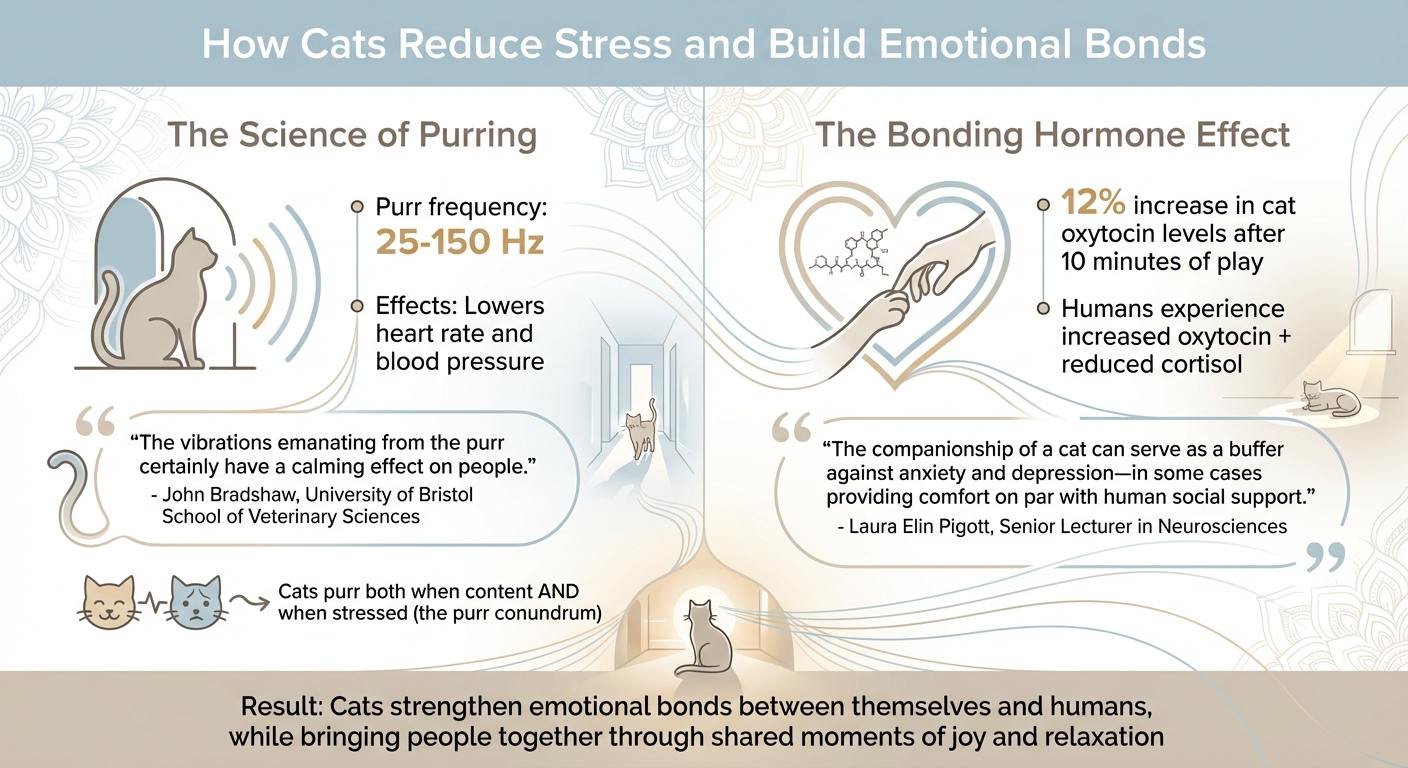
How Cats Reduce Stress and Build Emotional Bonds: Key Research Findings
Cats have an incredible ability to weave themselves into the emotional lives of those around them, offering comfort and connection in ways that feel almost effortless.
How Purring Reduces Stress
The soothing hum of a cat’s purr, which vibrates between 25 and 150 Hz, is more than just a sign of their contentment - it has a calming effect on humans as well. John Bradshaw, a Visiting Fellow at the University of Bristol School of Veterinary Sciences, explains, "The vibrations emanating from the purr certainly have a calming effect on people." Studies support this, showing that the low-frequency sound of purring can lower heart rate and blood pressure, helping the body relax and unwind. When your cat curls up and purrs beside you, it’s as if they’re inviting you into their peaceful world.
Interestingly, cats don’t only purr when they’re happy. They may also purr during stressful moments or when in pain, as a way of seeking comfort. This dual purpose, often called the "purr conundrum", highlights the importance of context. A cat purring contentedly in your lap is likely at ease, while a cat purring while hiding or acting unusually may be signaling a need for reassurance. In either case, the act of purring creates a quiet yet profound connection, bridging the emotional gap between human and feline.
How Shared Cat Interactions Bring People Together
Interacting with a cat - whether through gentle petting, playful moments, or even just quiet companionship - has a way of bringing people closer. These moments trigger the release of oxytocin, often called the "bonding hormone", in both cats and humans. A 2016 study revealed that cats experienced a 12% increase in oxytocin levels after just ten minutes of play with their owners. Humans experience a similar shift, with activities like stroking or softly talking to a cat linked to increased oxytocin and reduced cortisol, the stress hormone.
Laura Elin Pigott, a Senior Lecturer in Neurosciences and Neurorehabilitation, notes that "the companionship of a cat... can serve as a buffer against anxiety and depression - in some cases providing comfort on par with human social support." This highlights how cats not only bring comfort but also strengthen emotional resilience.
When people share these interactions - whether it’s a family playing with a feather wand or friends enjoying a cat’s quiet presence - they’re creating shared moments of joy and relaxation. The cat acts as a subtle, unifying presence, helping to build connections between people as well. These small, everyday encounters with a cat don’t just entertain; they create a sense of harmony and deepen the emotional bonds within a home. Cats, in their quiet way, become the heart of shared experiences, making our lives a little more connected and a lot more meaningful.
How Cats Shape the Atmosphere at Home
Cats have a way of influencing the energy and mood in a home. Through their habits and routines, they quietly shape the atmosphere of every room they inhabit.
How Cats Bring Calm to a Space
Cats naturally create a sense of peace simply by being present. Their well-being is closely tied to having a stable and familiar environment. When a cat feels secure in its surroundings, this calmness seems to ripple through the home.
Notice how your cat gravitates toward sunny spots for naps or claims a high perch on a shelf. These small, everyday behaviors bring a sense of quiet contentment to your space. The simple act of a cat curling up in a sunny corner can set a gentle, soothing tone that others in the house might pick up on without even realizing it.
Cats are descended from a solitary, territorial ancestor. Unlike dogs, cats place more reliance on the security of their territory than on psychological attachments to people or other cats.
Cats also communicate their sense of comfort through scent marking. When they rub against furniture, doorways, or even your legs, they are establishing safe zones. These subtle actions send signals of reassurance and calm, creating an atmosphere of ease for both the cat and the people around them.
This calming presence lays the groundwork for how a cat’s routines can further influence the energy of a household.
How Cat Routines Affect Household Energy
Beyond their calming presence, cats’ daily routines bring structure and stability to a home. Cats thrive on consistency - whether it’s regular feeding times, play sessions, or quiet rest periods - and this predictability can help reduce stress for everyone. Studies even suggest that environmental enrichment and steady routines can lower stress markers in cats by about 50%.
Think about how your cat’s routine weaves into your own day. Their habits encourage mindfulness, inviting you to slow down and notice the quieter rhythms of life. This connection fosters a sense of balance and presence within the household.
Of course, not all moments are serene. Those sudden bursts of energy, often called the "zoomies", are your cat’s way of releasing built-up tension or boredom. Regular playtime helps channel this energy in a healthy way, contributing to a more peaceful home environment overall.
In homes with multiple cats, territorial dynamics play an even bigger role. Cats naturally establish social hierarchies, and limited resources - like food bowls, water stations, or litter boxes - can lead to competition and stress. Following the n+1 rule, where you provide one more resource than the number of cats, can help maintain harmony and reduce potential tension among feline housemates.
What Cats Teach About Presence and Connection
Cats have a way of influencing the atmosphere of a home, but their lessons go beyond that. They show us how to embrace presence without the need for constant action or performance, gently challenging our tendency to always be “doing.”
The Value of Stillness and Choosing When to Engage
Cats live in the moment, experiencing emotions as they come and letting them go just as quickly. Research by John Bradshaw, a Visiting Fellow at the University of Bristol School of Veterinary Sciences, highlights this unique quality. Cats, for instance, don’t dwell on feelings like jealousy once the situation has passed.
"For both species [cats and dogs] jealousy is an in-the-moment emotion they experience when they see that another individual is getting the attention they are craving: they don't remember being jealous once the moment has passed." - John Bradshaw, Visiting Fellow at the University of Bristol School of Veterinary Sciences
This ability to release emotions reminds us to stay grounded in the present and avoid clinging to fleeting feelings. Cats also teach us about meaningful engagement. Their tendency to approach on their own terms isn’t about being distant; it reflects their autonomy. Bradshaw points out that trust with a cat grows when we let them decide when to interact, rather than imposing our timing on them.
When a cat purrs beside you, it’s an invitation to pause and be fully present. They aren’t asking for multitasking or half-hearted attention - they want you to simply be there, in the moment. This quiet mindfulness is a powerful reminder of how intentional connection can be.
Finding Comfort in Silence and Shared Spaces
Beyond mindful engagement, cats show us that silence can be just as meaningful as words.
When a cat follows you silently or settles nearby without asking for anything, it’s a gesture of trust and companionship. Their quiet presence speaks volumes, as author Wulan Novianita beautifully captures:
"Sometimes affection isn't dramatic. Sometimes it just waits nearby." - Wulan Novianita, Author
Cats often communicate through subtle actions - a slow blink, a pause at the doorway, or simply sitting close by. These quiet gestures encourage us to notice the unspoken signals in our own relationships, the ones we might overlook in the rush of daily life.
This ability to find comfort in shared silence highlights how connection doesn’t always require activity or words. Sometimes, just being in the same space is enough. Cats remind us that these quiet, shared moments can bridge both physical and emotional distances, fostering a sense of closeness that feels effortless yet profound.
Conclusion: The Space Between
Cats don’t just exist in our homes - they transform them. They glide through rooms, never claiming them outright, yet leaving behind an air of calm that ties one space to the next. Their quiet presence weaves into the fabric of our routines, showing us that connection doesn’t have to be loud or constant to be felt deeply.
Through their deliberate movements and understated influence, cats remind us of profound truths: trust flourishes when boundaries are respected, stillness can carry more weight than action, and silence shared with someone you care for can speak volumes. These silent moments, often overlooked, become the foundation of our bond with them.
Cats approach relationships differently. They don’t equate love with control or connection with demands. Instead, they show us that the strongest relationships are built on respect, shared presence, and an acceptance of individuality.
It’s in the spaces between - the pauses, the transitions, the quiet moments - that cats truly live. They linger in the places we often rush through, teaching us to embrace the in-between. By watching their natural rhythm, we’re reminded to slow down and find meaning in life’s quieter corners.
Your cat isn’t just a pet sharing your home. They’re a gentle reminder that being present matters more than being busy, that independence and love can coexist, and that some of life’s most meaningful connections are found in the unspoken, comfortable silences.
FAQs
Why do cats sit in doorways and hallways so often?
Cats often choose to sit in doorways and hallways because these spots give them the perfect balance of observation and security. These areas serve as natural vantage points, allowing them to keep an eye on their surroundings while subtly asserting their presence. Being transitional spaces, doorways and hallways let cats patrol their environment without being confined to one specific area. This behavior ties closely to their instincts for curiosity, stalking, and staying aware of their territory.
How can I tell if my cat is purring from comfort or stress?
To figure out whether your cat's purring comes from contentment or stress, pay close attention to their body language and the context of the situation. While purring is usually a sign of relaxation, it can sometimes serve as a way for cats to comfort themselves during moments of stress, pain, or fear. Watch for additional signals, such as their posture, the position of their ears, and their overall behavior, to get a clearer sense of how they’re feeling.
How can I create a calmer home routine for my cat (and me)?
Creating a more relaxed home routine for you and your cat starts with consistency and a soothing atmosphere. Stick to regular schedules for feeding, playtime, and quiet moments, as cats thrive on predictability. Offer your feline cozy spots to unwind - whether it’s a soft blanket in a quiet corner or a sunny windowsill. Gentle, mindful interactions, like slow petting or simply sitting nearby, can deepen your bond. Adding group play sessions with engaging toys not only reduces stress but also strengthens your connection. These simple adjustments can bring a sense of calm and emotional balance to both your lives.


Leave a comment