

Cats perceive the world in ways we often overlook. Their sharp senses - like seeing in near-darkness, hearing ultrasonic sounds, and detecting subtle vibrations - allow them to notice details and changes we might miss entirely. For example, they can sense your emotions through scent, interpret your body language, and even respond to shifts in household energy. These abilities influence how they interact with you and their environment, forming deeper connections than we realize.
Here’s what stands out about how cats experience life:
- Vision: Cats see motion and patterns, even in dim light, and their wide field of view helps them stay alert.
- Hearing: They detect high-pitched sounds, including ultrasonic frequencies, and recognize familiar voices.
- Smell: With a sense 14 times stronger than ours, cats use scent to map spaces, identify people, and sense mood changes.
- Touch: Whiskers and paw pads help them navigate and interpret their surroundings with incredible precision.
- Emotional Awareness: Cats pick up on your stress, calmness, or happiness and often mirror these feelings.
Understanding these traits can help you build a stronger bond with your cat by respecting their unique perspective. Whether it’s creating safe spaces, using familiar scents, or simply observing how they respond to subtle changes, your cat’s behavior offers valuable insights into their world - and yours.
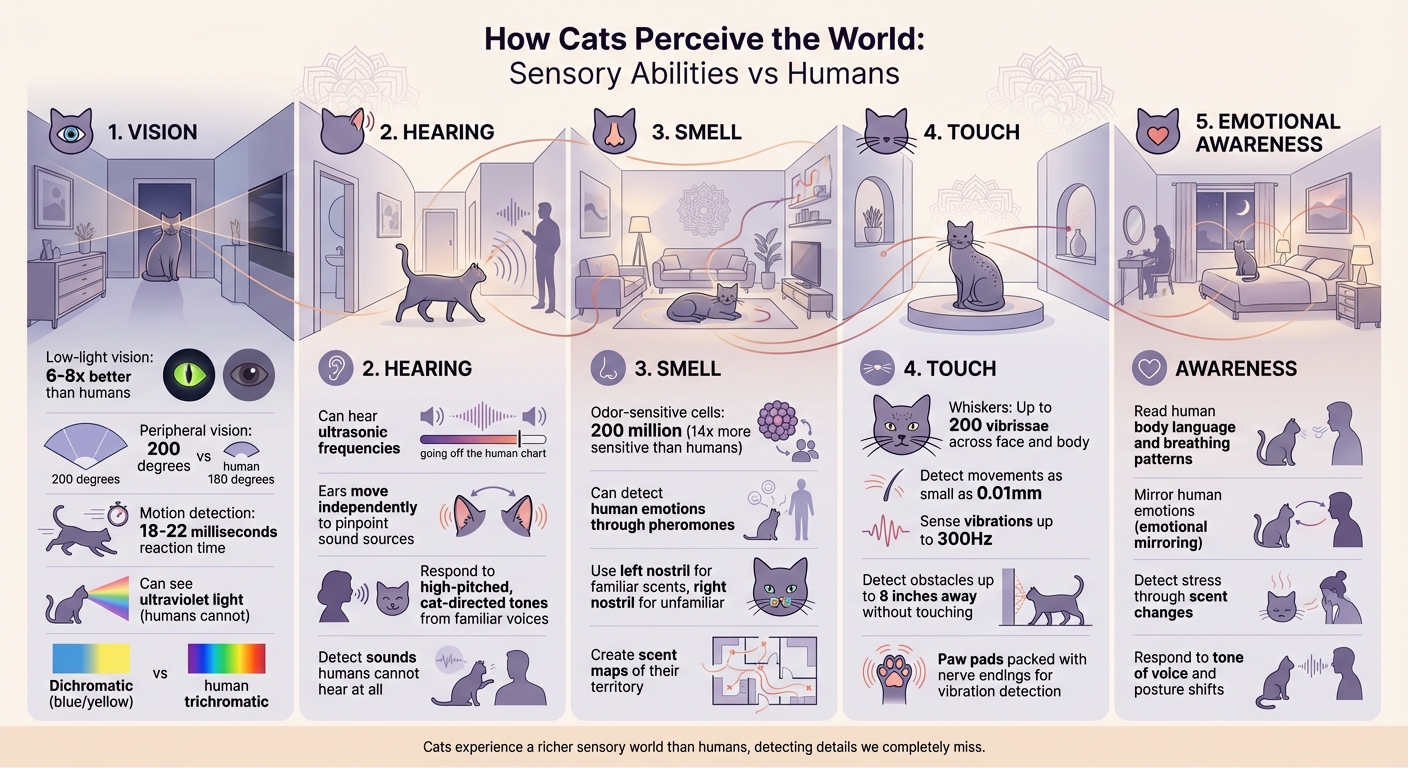
Cat vs Human Sensory Abilities Comparison Chart
How Cats See Beyond What Humans Notice
Your cat's vision reveals a world far richer than what your eyes can perceive. While you might glance at a dim corner and see nothing unusual, your cat detects layers of movement, shadow, and even ultraviolet patterns that are completely hidden to you. Their way of processing visual information is uniquely their own.
"Understanding cat perception means accepting that the world you see isn't the world your cat sees." - Adam Gill, Cat Cognition: The Science of Cat Care
Seeing in Low Light and Detecting Small Movements
Cats have an extraordinary ability to see in low light and detect even the slightest motion. This is thanks to a specialized structure in their eyes called the tapetum lucidum. Positioned behind the retina, it reflects light back through the eye, effectively doubling light sensitivity. This allows cats to see 6 to 8 times better than humans in near-darkness. That eerie glow in their eyes when light hits them just right? That’s the tapetum lucidum doing its job.
As crepuscular hunters - most active during dawn and dusk - cats are fine-tuned to spot movement in dim conditions. Their vision prioritizes motion over detail and color. For instance, while you might miss a moth fluttering across a shadowy room, your cat locks onto it with ease. They can also perceive ultraviolet light, revealing patterns and trails in their surroundings that you would never notice.
This also explains why a red laser pointer is so irresistible. The color itself doesn’t stand out to cats - it likely looks dull gray or brown to them. Instead, it’s the quick, unpredictable movements that trigger their hunting instincts. When picking out toys, consider ones in blue or yellow, as these colors appear more vivid to cats with their dichromatic vision.
Their ability to thrive in low light goes hand-in-hand with their heightened spatial awareness.
Wide Field of View and Spatial Awareness
Cats have a peripheral vision range of 200 degrees, compared to the 180-degree field humans enjoy. This wider range allows them to keep tabs on nearly everything around them, even when it seems like they’re focused straight ahead. It’s an evolutionary advantage, helping them detect potential threats or prey from almost any angle.
However, this comes with some compromises. Cats don’t see close-up details as sharply as humans, and their color range is limited. But what they lack in clarity, they more than make up for in their ability to detect motion. Anything that suddenly enters their peripheral vision can trigger an instant reaction in just 18 to 22 milliseconds. This explains the infamous "cucumber phenomenon", where cats leap dramatically when a new object appears unexpectedly behind them in a space they consider safe.
Recognizing these traits can help you create a more comfortable environment for your cat. Avoid placing unfamiliar objects in their favorite areas, such as near their feeding stations or resting spots. Position cat trees or perches near windows, giving them a chance to use their exceptional motion-tracking skills to observe outdoor activity. When your cat startles at something you barely notice, it’s not overreaction - it’s their finely tuned visual system at work.
These unique visual abilities allow your cat to interact with a world you can’t fully see, offering a glimpse into how they experience life. By understanding this, you can create a home that respects their perspective and keeps them at ease.
sbb-itb-b6c1dc0
What Cats Hear That You Can't
Your cat’s ears are like tiny, furry radar dishes, swiveling independently to pick up sounds you’d never notice. Even in a seemingly silent room, your cat is tuned in to ultrasonic frequencies and faint vibrations, staying deeply connected to its surroundings.
Hearing High-Pitched Sounds and Ultrasonic Frequencies
Cats have an extraordinary ability to hear ultrasonic sounds, a trait that serves them well as hunters. Small rodents, like mice, communicate with high-pitched squeaks that are far beyond what humans can detect. So, when your cat suddenly perks up and stares at an empty wall, it might be responding to these ultrasonic cues - sounds that exist entirely outside your range of hearing.
"They can hear ultrasonic sounds, frequencies far beyond the range of human hearing. This is critical for hunting small rodents, which communicate using high-pitched squeaks." - The Institute for Environmental Research and Education
In October 2022, ethologist Charlotte de Mouzon from EthoCat and the University of Paris Nanterre conducted a study, published in Animal Cognition, involving 16 cats in Bordeaux, France. The study found that cats reacted noticeably - turning their ears or swishing their tails - when they heard their owners speaking to them in high-pitched, cat-directed tones. Interestingly, they ignored the same tone when it was spoken by a stranger. This suggests that cats not only detect high frequencies but also use them to recognize and respond to familiar voices.
Their ability to move their ears independently helps them pinpoint where a sound is coming from. That’s why speaking to your cat in a higher pitch, combined with simple phrases, often grabs their attention. But their sharp hearing isn’t the only way they pick up on their environment - they’re also highly attuned to physical vibrations.
Feeling Vibrations and Sensing Coming Events
Cats are remarkably sensitive to ground vibrations and subtle pressure changes. This ability allows them to detect things like approaching storms or even minor tremors before you’re aware of anything unusual. If your cat suddenly becomes restless or retreats to a quiet hiding spot, it might be reacting to vibrations or shifts that are completely undetectable to you.
Through their paws and whiskers, cats interpret these subtle signals as part of their connection to the world around them. It’s not about predicting events but rather accessing information that most of us miss. This heightened awareness makes their experience of the world much richer and more layered than we often realize.
How Scent Creates Emotional and Physical Connections
Your cat’s sense of smell is a gateway to a world we can barely imagine. With around 200 million odor-sensitive cells - a sensitivity 14 times greater than ours - cats rely heavily on scent to understand their surroundings and even to interpret your emotions. This extraordinary ability shapes their behavior and deepens their bond with you.
Detecting Human Emotions Through Smell
Did you know your cat can sense when you’re stressed, anxious, or unwell? Changes in your body’s pheromones and scent markers give away these emotional shifts, and your cat picks up on them even before you say or do anything noticeable. They’re not just observing; they’re responding to chemical cues that reveal how you’re feeling.
In a fascinating study published in May 2024 in PLOS One, Yutaro Miyairi and researchers from the Tokyo University of Agriculture explored how cats recognize their owners through scent. They tested 30 domestic cats with swabs taken from their guardians’ armpits, behind their ears, and between their toes, as well as from strangers. The results were striking: cats spent much less time sniffing their guardian’s scent, recognizing it almost instantly, while they lingered longer with unfamiliar smells. Even more intriguing, cats used their left nostril for familiar scents and their right nostril for unfamiliar ones, suggesting their brains process these scents differently.
This might explain why your cat seems to appear out of nowhere when you’re upset or unwell. They’re not guessing - they’re responding to actual chemical signals that tell them something has changed. When cats rub against you, they’re not just being affectionate; they’re sharing their scent with you, reinforcing a bond that’s both emotional and physical.
But scent isn’t just about relationships - it’s also how your cat defines and secures its space.
Using Scent to Map and Secure Their Territory
Your cat’s world is mapped out by scent. Every time they rub against furniture, walls, or even you, they’re leaving markers that create an invisible map of their territory. These scent markers help them feel grounded and safe, transforming your home into a space they recognize as their own.
"Familiar scents can also be comforting to cats, reducing stress and anxiety and creating a sense of security within their environment." - Julia Henning, PhD Candidate in Feline Behaviour, University of Adelaide
This is why deep-cleaning with strong chemicals or rearranging furniture can unsettle your cat. It wipes away their scent map, leaving them disoriented. If your cat seems restless after such changes, they’re likely trying to re-establish their scent markers to regain a sense of control. Offering them something familiar, like an unwashed piece of clothing, can help during stressful times, such as vet visits or moving to a new home. These familiar smells act like an anchor, providing comfort in unfamiliar situations.
Through scent, your cat weaves a complex tapestry of emotional and physical connections, making your shared space feel like home for both of you.
Touch and Vibration: How Whiskers and Paws Sense the World
Cats experience their surroundings in ways that go far beyond what we can see or hear. For them, touch is a powerful tool, and their whiskers and paw pads act as finely tuned sensors. These features help them pick up subtle vibrations and spatial details, creating an invisible map of their environment.
How Whiskers Help Cats Navigate
Whiskers are more than just decorative - they're finely tuned instruments. Each one is much thicker than regular fur and rooted in tissue packed with nerves, making them incredibly sensitive. Cats have up to 200 whiskers, or vibrissae, spread across their face and body, including their upper lips, cheeks, chin, above their eyes, and even the backs of their front legs. These whiskers are constantly gathering information about their surroundings.
"Each of a feline's whiskers grows from a follicle packed with nerves and blood vessels, making them as sensitive as human fingertips." - Carrie Arnold, Author
Whiskers can detect tiny movements as small as 0.01mm and pick up vibrations up to 300Hz. They even respond to changes in airflow, helping cats sense obstacles up to 8 inches away without touching them. When hunting or moving in the dark, cats can adjust their whiskers into a "basket" shape, allowing them to pinpoint prey with remarkable accuracy.
This heightened sensitivity means that trimming a cat's whiskers can be extremely stressful for them, causing disorientation similar to being blindfolded. Even something as simple as deep food bowls can lead to "whisker fatigue", where overstimulation makes eating uncomfortable. Switching to wide, shallow bowls can help relieve this issue. And while whiskers are crucial, a cat’s paw pads also play a vital role in their tactile world.
What Paw Pads Tell Cats About Their Environment
A cat's paw pads aren't just for cushioning their steps - they're sensory hubs. Packed with nerve endings, they detect vibrations, temperature, and textures with precision. Paw pads are so sensitive that they can even pick up the vibrations from a cat’s own purring, which often serves as a way to self-soothe during stressful situations.
As cats walk, their paw pads gather information about the surface beneath them, assessing its safety, temperature, and even subtle movements that might signal nearby activity. This sensitivity explains why cats might hesitate to step on unfamiliar textures or avoid hot pavement and cold tiles.
Paw pads also have scent glands that release pheromones when cats scratch or knead. So, when your cat kneads your lap or scratches furniture, they're not just stretching - they’re marking their territory with their unique scent. If you’ve ever noticed damp paw prints at the vet’s office, that’s your cat’s sweat glands in action, often a sign of stress or anxiety.
Interestingly, cats tend to favor one paw over the other. Studies suggest that male cats are often left-pawed, while females lean toward being right-pawed. You can spot your cat’s preference by watching which paw they use first when reaching for a toy or stepping forward.
How Cats Read and Respond to Human Emotions
Cats are incredibly attentive creatures, often picking up on details we might not even notice ourselves. They don’t just watch what we do; they seem to tune into every small movement, shift in posture, or change in breathing. These subtle observations allow them to interpret our emotional states, making them surprisingly intuitive companions in the home.
Reading Body Language and Emotional States
Your cat’s ability to read body language is almost uncanny. A stiff, tense posture might make them hesitant, while a relaxed demeanor invites them to come closer. They notice the little things - how your shoulders slump after a tough day, the way your breathing quickens when you’re stressed, or the lightness in your movements when you’re feeling happy. Even your tone of voice matters. A sharp or loud tone might send them scurrying for cover, while a soft, calm voice reassures them and encourages connection.
Interestingly, cats often mirror our emotions, a behavior known as emotional mirroring. If you’re feeling stressed or calm, your cat may reflect that energy back to you. For example, a peaceful, yawning cat might be echoing your sense of calm, while a restless one could be picking up on tension in the room. This mirroring creates a unique bond, blending your emotional world with the atmosphere of your home.
"Cats are emotional barometers." - Gentle Purrs
Studies have shown that the emotional environment of a household can directly impact a cat’s well-being. High-stress homes, for instance, have been linked to health issues in cats, such as urinary tract problems. This means your cat’s behavior isn’t just a reflection of their personality - it’s often a response to the emotional tone you set. Their vocalizations, from soft meows to insistent chirps, further strengthen this emotional connection, adding depth to the way they communicate with you.
How Cats Influence the Energy of a Home
Cats don’t just respond to the energy in a home - they actively shape it. Their presence can bring a sense of calm or balance that affects everyone around them. When a cat curls up quietly in a room, it can create a soothing atmosphere. On the other hand, when they’re playful and energetic, they often amplify a cheerful mood. In this way, cats act as both mirrors and mood-setters, subtly influencing the environment they inhabit.
When your cat seeks out a quiet corner or high perch, it might be their way of signaling a need for solitude - either because they sense overstimulation or because they’re reflecting your own need for rest. Creating safe spaces, like cozy nooks or elevated spots, allows them to retreat when the household energy feels overwhelming. A consistent routine for feeding, play, and rest also helps them feel secure, which in turn contributes to a more harmonious living space. In many ways, your cat’s behavior serves as a barometer for the overall balance and energy of your home.
What You Can Learn from Your Cat's Perspective
Your cat’s unique way of navigating the world can teach you a surprising amount about how to approach life. While humans often overthink and analyze every detail, cats rely on their senses and an instinctive understanding of when to hold on and when to let go.
Cats focus on movement rather than details. Instead of fixating on every little thing in their environment, they respond to changes that matter - what’s moving, shifting, or catching their attention. For humans, this can be a reminder to concentrate on what’s happening right now. When you feel overwhelmed by endless information or decisions, try filtering out the noise and tuning into what’s actively changing around you. It’s a way to stay present and avoid unnecessary stress.
Another lesson comes from how cats deal with frustration. As anthrozoologist John Bradshaw explains:
"If there's a problem, cats try to solve it on their own. And if they fail, they just walk away."
Cats don’t waste time or energy on problems they can’t solve. They attempt a solution, and if it doesn’t work, they move on. This isn’t about giving up - it’s about understanding limits and avoiding unnecessary frustration. When you’re stuck on something that feels impossible, taking a step back - or even walking away - can help you reset and see things more clearly.
Cats are also masters of quiet observation, often noticing the smallest details that others miss. Whether it’s a subtle sound or a tiny movement, they’re attuned to their surroundings in ways that can inspire you to slow down and pay closer attention. Look for the quiet cues in your environment: a shift in someone’s tone, the way light changes in a room, or the faint rustle of leaves. These small details can carry meaning that louder, more obvious signals might overshadow.
Lastly, cats remind us to stay grounded through sensory awareness. Just as their whiskers detect even the gentlest breeze, you can tune into your own physical sensations to anchor yourself in the moment. Notice the texture of what you’re touching, the temperature of the air, or the way your body feels in a chair. These small acts of awareness pull you out of your thoughts and into the here and now - a place where cats seem to live effortlessly.
Conclusion: Living More Like Your Cat
Your cat navigates a world filled with layers you might never notice. While you see walls and furniture, they’re tracing an intricate map of emotions and territory through scent - a map you unknowingly walk past. While you hear the hum of a refrigerator, they’re picking up on faint sounds and pinpointing their exact source with ease.
This difference can prompt a thoughtful question: What am I missing right now? When your cat stops to sniff the air or becomes transfixed by a seemingly empty corner of the room, let that moment nudge you to pause. Consider what small details might be escaping your attention. You don’t need their heightened senses to gain something from their perspective. All it takes is a willingness to slow down and notice - the texture of surfaces under your hands, the quiet sounds that sit beneath the obvious ones, or the subtle energy shift when someone enters a space.
These small shifts in awareness can help us better understand how deeply connected our emotions are to our surroundings. From the way we see and hear to how we feel and sense, your cat’s behavior offers a quiet reminder to be present and mindful in every moment. Let their actions inspire you to reconnect with the world around you.
To live like your cat is to trust your instincts over overthinking, to recognize when it’s time to step back instead of forcing a solution. It’s about understanding that the most meaningful connections - whether with spaces, people, or the moment itself - are often invisible but can be deeply felt if you’re paying attention.
Your cat has been showing you this way of living all along. The real question is: Are you ready to notice?
FAQs
Can my cat really sense my stress or mood?
Cats have an uncanny ability to sense human emotions, including stress, sadness, and anxiety. They notice small visual and auditory changes, such as your tone of voice or body language, and can even detect shifts in scent when you're feeling different. This awareness allows them to adjust their behavior, often offering quiet comfort or simply staying close when you need it most.
Why does my cat stare at empty corners or walls?
Cats often behave in ways that seem mysterious to us, but much of it ties back to their incredibly sharp senses. They can pick up on movements, sounds, or smells that we might completely miss - like the faint rustle of an insect or a barely noticeable shift in their surroundings. Their reactions often reflect their natural instincts as hunters, always alert and ready to respond. While this behavior is usually just a glimpse into how they experience the world, a sudden and unusual change in these habits could occasionally hint at sensory or neurological concerns. However, in most cases, it's simply a harmless expression of their unique perception.
How can I make my home feel safer to my cat?
To create a home where your cat feels secure, it helps to think about their natural instincts. Cats often seek out high places to climb, so offering vertical spaces like shelves or cat trees can make them feel more at ease. They also appreciate cozy, hidden spots where they can retreat when they need some quiet time. If your home has multiple levels, placing a litter box on each floor can make their daily routines easier.
Be mindful of potential hazards, like toxic plants, and make sure any outdoor access is safe - something like a secure catio can give them a taste of the outdoors without any risks. Paying attention to your cat’s behavior and preferences will help you shape a space that feels comfortable and safe for them.


Leave a comment