

Words beginning with "I" hold a quiet power. They guide us inward, offering clarity, calm, and connection in our daily lives. From kind words that uplift others to the steady nudge of intuition, these terms reflect inner growth and mindfulness. Infinite possibilities remind us to dream, while insight deepens our understanding. The beauty of intricate designs, like mandalas, centers the mind, and moments of illumination bring light to our thoughts. These words are more than vocabulary - they're tools for reflection, offering balance and meaning in even the simplest moments.
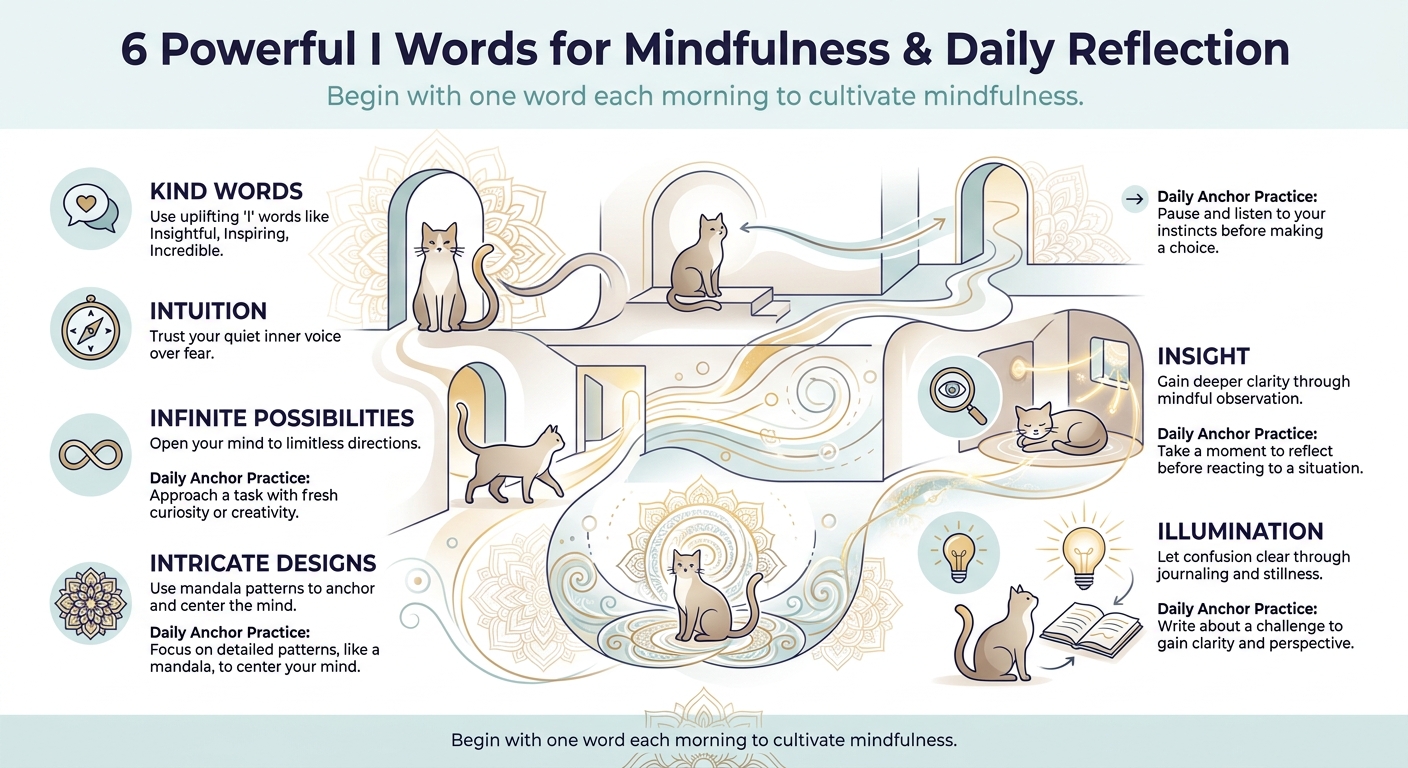
6 Powerful 'I' Words for Mindfulness & Daily Reflection
1. Kind Words
The words we choose to describe others - and ourselves - carry a surprising amount of weight. Using kind words, especially those that begin with "I", can reveal deeper character and values, going beyond surface-level compliments.
Consider the difference between saying "good job" and describing someone's contribution as "insightful." The latter shows that you truly heard them and appreciated the thoughtfulness behind their input. That small change can make someone feel truly understood.
Here are a few "I" words to consider adding to your vocabulary:
| Kind Word | How to Use It |
|---|---|
| Insightful | Use this when someone shares a thoughtful idea or perspective, showing you value their depth. |
| Incredible | Acknowledge someone's genuine effort or achievement with this word. |
| Inspiring | Say this when someone's words or actions light a spark in you. |
| Inviting | Use this to describe a person or space that feels warm, open, and welcoming. |
| Impeccable | Save this for moments when someone shows extraordinary care or precision. |
These words go beyond simple compliments - they help strengthen the qualities you value in your relationships. For example, calling someone "inspiring" not only uplifts them but also encourages you to notice what stirs something meaningful in you.
Next, we'll explore intuition, that quiet guide within us that shapes our inner journey.
sbb-itb-b6c1dc0
2. Intuition
Trusting Your Inner Knowing
Intuition often feels like a gentle nudge, a quiet sense that something is either right or wrong, long before logical reasoning steps in. It’s that subtle inner voice that speaks with calm certainty. To connect with this inner sense, try the "Five Breaths" rule: pause, take five slow, deep breaths, and pay attention to how your chest and belly feel. These physical sensations can often reflect your true inner guidance.
"Fear screams. Intuition nudges. Fear catastrophizes. Intuition just kind of knows." - Calm Editorial Team
The challenge lies in distinguishing fear from intuition. Fear tends to be loud, anxious, and overwhelming, while intuition is steady, quiet, and composed. Learning to tell them apart helps you make choices with clarity and confidence.
Trusting this inner compass can lead to more mindful living, setting the stage for endless opportunities to explore in the next section.
3. Infinite Possibilities
Opening Your Mind to What's Possible
The word "infinite" suggests something without limits. When you bring this idea into your life, it shifts how you see the world. Instead of feeling confined to a single path, you start to notice the countless directions you could take.
Imagination plays a huge role in this shift. It’s the ability to dream up ideas and concepts that go beyond what you can currently see or feel. This creative energy isn't just about daydreaming - it’s a way to uncover fresh opportunities and explore them in practical, meaningful ways.
"Imagination, Integrity, and Intuition are powerful tools for navigating life with purpose." - Positivity.org
One way to nurture this mindset is by stepping outside your comfort zone. Try picking up a hobby you’ve never considered, visiting a part of town you’ve never explored, or diving into a creative activity that feels unfamiliar. These small acts, guided by your inner sense of curiosity and confidence, can help you see the world - and yourself - in new ways.
Taking the first step often requires initiative. When you act on your own, even in small ways, you can transform moments of stagnation into opportunities for growth.
This outlook naturally leads to a deeper understanding, setting the stage for the next phase of discovery.
4. Insight
Seeing Clearly From the Inside Out
Insight is more than a fleeting moment of understanding. It’s about gaining a deeper clarity about yourself, your experiences, and the way you interact with the world.
"Insight helps us see and understand our selves, life and the world realistically." - Insight Timer
Rooted in mindfulness, insight grows through observing your mind and body without attaching judgment. It’s about noticing the flow of thoughts, observing how they feel, and letting them pass naturally. Over time, this practice helps uncover patterns in how you think and react, allowing you to approach situations with intention rather than habit.
A simple yet effective way to nurture this skill is through "noting". This involves quietly labeling what you’re experiencing in the moment. For instance, if your mind drifts during a peaceful pause, you might mentally note "thinking" or "planning." This small act of acknowledgment strengthens your focus and keeps you connected to the present.
As you deepen this practice, you begin to see the temporary nature of thoughts and emotions. This awareness can create a sense of freedom, reducing stress and self-doubt. Over time, this clearer inner perspective naturally paves the way to understanding the patterns that influence how we express ourselves creatively.
5. Intricate Designs
The Mandala as a Mirror for the Mind
Mandalas, with their intricate patterns, offer a rare opportunity for the mind to find a resting place - a moment of calm in a chaotic world.
The term mandala, rooted in Sanskrit, translates to "circle", but its meaning extends far beyond its shape. These layered, symmetrical designs invite total immersion. Their complexity demands focus, gently pulling your attention away from distractions and anchoring you in the present moment.
"Each person's life is like a mandala – a vast, limitless circle. We stand in the center of our own circle, and everything we see, hear and think forms the mandala of our life." - Pema Chodron
Psychologist Carl Jung recognized the profound impact of mandalas, incorporating them into his therapeutic work. He described them as:
"The mandala is an archetypal image whose occurrence is attested throughout the ages. It signifies the wholeness of the Self." - Carl Jung
How to engage with intricate designs: Before coloring or meditating on a mandala, take a moment to set an intention. Whether you aim to find clarity, ease a restless mind, or simply breathe deeply, let that purpose guide you. As your eyes trace the detailed lines of the mandala, allow the design to ground your thoughts. If your mind begins to wander, gently return your focus to the patterns - this simple act of refocusing can be profoundly centering.
Colors also play a role in this process. For example, orange tones encourage intuition and transformation, while blue hues promote emotional healing. Choosing colors with intention transforms the act of creating or observing into a reflective and meaningful experience.
Blululi's mandala designs embody this idea. These digitally crafted patterns, created with layered color algorithms, are mesmerizing and purposeful. Whether worn or displayed, a mandala becomes more than an object - it acts as a quiet reminder to stay grounded. This subtle presence can help create moments of clarity and connection in everyday life.
6. Illumination
Letting Light In
Illumination is that gentle moment when confusion begins to clear, and your thoughts settle into place.
It’s not about sudden revelations, but rather a quiet process of organizing your mind. Taking time to pause - whether through journaling, meditation, or even sitting in stillness - can help untangle the knots of uncertainty. These moments of reflection create space for clarity to emerge.
A helpful approach: When faced with something overwhelming or unclear, try writing it down. Putting your thoughts into words encourages your mind to structure them. Often, the act of explaining a situation, even to yourself, can uncover insights you didn’t realize were there. Writing bridges the gap between inner reflection and the clarity that follows.
Drawing inspiration from mandalas, notice their radiating patterns. They naturally draw your focus inward, calming the mind and helping you connect with a deeper sense of understanding. This is the heart of illumination: discovering answers not by looking outward, but by turning inward to uncover what’s already within. Like the quiet, steady presence of a cat, this inner light offers a sense of balance and awareness.
Conclusion
The six I words discussed - Kind Words, Intuition, Infinite Possibilities, Insight, Intricate Designs, and Illumination - go beyond mere vocabulary. They act as touchstones, offering a sense of direction when life feels overwhelming or uncertain.
What makes these words meaningful is their straightforwardness. Choosing just one each morning and letting it shape your responses throughout the day - whether at work, at home, or even on the go - can bring a refreshing sense of clarity to your routine.
"The greatest gift you can give yourself is the gift of mindfulness." - Jon Kabat-Zinn, founder of Mindfulness-Based Stress Reduction (MBSR)
These words also encourage a deeper connection with the world around you. For instance, practicing insight allows you to observe your thoughts without judgment, while intuition reminds you to trust your inner voice. Even something as simple as watching your cat's serene, deliberate movements can serve as a gentle nudge to slow down and be present. This quiet act of observation mirrors the patience and care we bring to everyday life, reinforcing how mindfulness can enhance even the smallest moments.
Here’s a quick guide to incorporating these words into your daily life:
| I Word | Daily Anchor Practice |
|---|---|
| Intuition | Pause and listen to your instincts before making a choice |
| Illumination | Write about a challenge to gain clarity and perspective |
| Infinite Possibilities | Approach a task with fresh curiosity or creativity |
| Insight | Take a moment to reflect before reacting to a situation |
| Intricate Designs | Focus on detailed patterns, like a mandala, to center your mind |
| Kind Words | Offer a kind thought or word to yourself or someone else |
By incorporating these practices, you can cultivate mindfulness and strengthen your connection to both your inner world and the peaceful presence of your cat.
Begin with just one word - perhaps during a quiet morning moment, a thoughtful walk, or a few deep breaths. Over time, these anchors will naturally weave into your thoughts, guiding your actions and enriching your daily life.
FAQs
How do I tell intuition from fear?
To tell the difference between intuition and fear, pay attention to the way each one feels. Intuition tends to come across as calm and steady, offering a quiet sense of clarity and peace. Fear, however, is often loud and overwhelming, filled with emotional intensity. Taking time to meditate can help you slow down and notice these signals in your body - intuition feels grounded and soothing, while fear usually carries a frantic, unsettled energy.
How can I use one “I” word as a daily habit?
Incorporating an "I" word into your daily life can be a simple yet meaningful way to encourage mindfulness and self-improvement. Take “Imagination,” for example - spend time visualizing your goals or exploring creative ideas to bring more clarity and inspiration to your day. Or consider “Integrity,” using it as a reminder to align your actions with your values, fostering a deeper sense of self-awareness. By selecting a different "I" word each day, you can build intentional habits that promote a more mindful and thoughtful way of living.
How do mandalas help with mindfulness?
Mandalas draw attention inward through their circular and balanced designs, creating a calming effect that encourages mindfulness. Their intricate patterns invite you to stay present, helping to ease stress while fostering moments of emotional introspection. This makes them an effective way to promote self-awareness and a sense of relaxation.


Leave a comment