


Cats Connect What Walls Divide - And That Includes Us
It’s a quiet evening at home. You’re in one room, your partner in another, each absorbed in separate routines. The house feels divided, as if the walls between you are more than just physical. Then, the cat appears. She moves effortlessly between spaces, weaving through barriers as if they don’t exist. A soft nudge, a gentle meow - suddenly, the distance feels smaller.
Cats have a way of connecting what we’ve unconsciously separated. They see the home not as a collection of rooms but as one shared space. Their quiet movements remind us that connection doesn’t always require effort or words. Sometimes, it’s as simple as being present.
How Modern Homes Divide Us
Homes are created with specific functions in mind: a place to sleep, cook, or work. Each room has its role, and the walls and doors that define these spaces offer privacy and order. But in this careful organization, something else happens - distance quietly grows between us.
The very design that structures our lives can also separate us. Traditional layouts lack smooth transitions between spaces. Picture this: you're folding laundry in one room, while your partner scrolls on their phone in another. You're under the same roof, yet living in different worlds. The walls that bring order also make it easier to drift apart. And then there’s the cat - wandering effortlessly through these barriers, defying the routines we’ve compartmentalized. Let’s explore cat behavior from a wider point of view.
Living Together, Yet Apart - How Cats See Space
In the United States, over 30% of households share their home with at least one cat. Yet, as Margaret Gates, Founder of the Feline Nutrition Foundation, points out:
"The majority of people in the US own pets, yet houses are designed with complete disregard for this fact. If homes are to become more user-friendly, builders must recognize that creatures other than humans use them."
This observation highlights something deeper about how we live. Even when we share a home, our lives often run on parallel tracks. Breakfasts are eaten at different times, evenings are spent in separate rooms, and screens or books absorb our attention. The walls that divide physical space can reflect emotional distance, a gap we may not notice until something - or someone - unexpected crosses it.
Doors close for more than privacy - they manage noise, temperature, and even isolation. Yet in this quiet separation, a cat’s movement stands out. They slip through unnoticed spaces, a silent reminder that connection isn’t always planned. Their presence can prompt us to rethink how we interact - not just with each other, but with the spaces we share. In their quiet way, cats show us that even small gestures can bridge the divides we might otherwise ignore.
How Cats See Space Differently
While we might label rooms as distinct areas - kitchen, bedroom, office - cats experience them in a completely different way. To a cat, the home is a single, continuous territory, carefully marked and claimed through subtle gestures. They use the scent glands on their face and chin to mark furniture, doorways, and other surfaces, creating an invisible map of safety and familiarity.
John Bradshaw, a Visiting Fellow at the University of Bristol School of Veterinary Sciences, sheds light on this:
"Cats are much more sensitive than dogs are to any change in their environment because they are territorial animals that get their sense of security from the place where they live."
This heightened sensitivity influences how they move through space. Cats glide seamlessly from one room to another, instinctively aware of everyone’s movements and moods, without waiting for an invitation.
In October 2024, biologist Péter Pongrácz from Eötvös Loránd University conducted a study with 29 cat owners in Budapest. Using cardboard panels with different-sized holes, the research showed that cats rely on mental body-size awareness to judge whether they can fit through tight spaces. About 73% of cats hesitated before attempting smaller openings, indicating they carefully plan their movements with a level of cognitive awareness. By moving through our structured spaces with such fluidity, cats remind us of the connections that lie beyond rigid boundaries.
Messengers Without Words
This awareness isn’t limited to physical navigation - it also shapes how cats connect us. Imagine you’re working at your desk, deeply focused. A cat strolls in, rubs against your leg, and then wanders off. Moments later, they’re doing the same to someone else in another room. Without uttering a word, they’ve created a link between two separate worlds.
This behavior isn’t random. Cats have developed what researchers call a "private language" of meows to communicate with humans. Unlike feral cats, which rarely vocalize with one another in adulthood, house cats have learned that meowing gets our attention. It pulls us out of isolation, even if just for a second.
In January 2025, evolutionary psychologist Brittany Florkiewicz and computer scientist Anna Zamansky used AI to study the interactions of cats like "Darth Vader" and "Charmander" in a home in Arkansas. They found that cats use quick facial cues, such as ear twitches or subtle mouth movements, to signal playfulness or ease social tension. As Florkiewicz explains:
"Facial mimicry tells them, 'Is my playmate still having fun? Are we still building a positive social bond?'"
Through these quiet gestures, cats don’t just move between rooms - they remind us to connect, even in the smallest ways.
From Solitude to Shared Moments
A cat’s presence has a way of transforming the energy in a home. Picture this: you’re reading alone in the living room while your partner cooks in the kitchen. The cat moves between you both, pauses, and then settles in a spot where they can see you both. Suddenly, without meaning to, you and your partner notice the same thing - and in that shared moment, a connection is formed.
Cats don’t recognize the emotional boundaries we often create. They don’t see "your space" or "my space." To them, it’s all one shared territory. When a cat chooses to sit near you, it’s deliberate, not random. Studies show that when cats mirror a companion’s facial expression, they follow it with friendly behaviors - like playing or grooming - nearly 60% of the time.
Cats teach us that connection doesn’t always need words. Sometimes it’s about presence. A slow blink from across the room. A quiet nudge. A decision to simply be near. In homes where people often live parallel lives, a cat’s movement can act as a thread, gently weaving everyone back together - much like the symbolism behind why cats are thought to visit certain homes in the first place.
This quiet, unspoken connection offers a reminder of how even the simplest interactions - both at home and in other aspects of life - can bring us closer together.
Why Cat Videos Connect Us Online
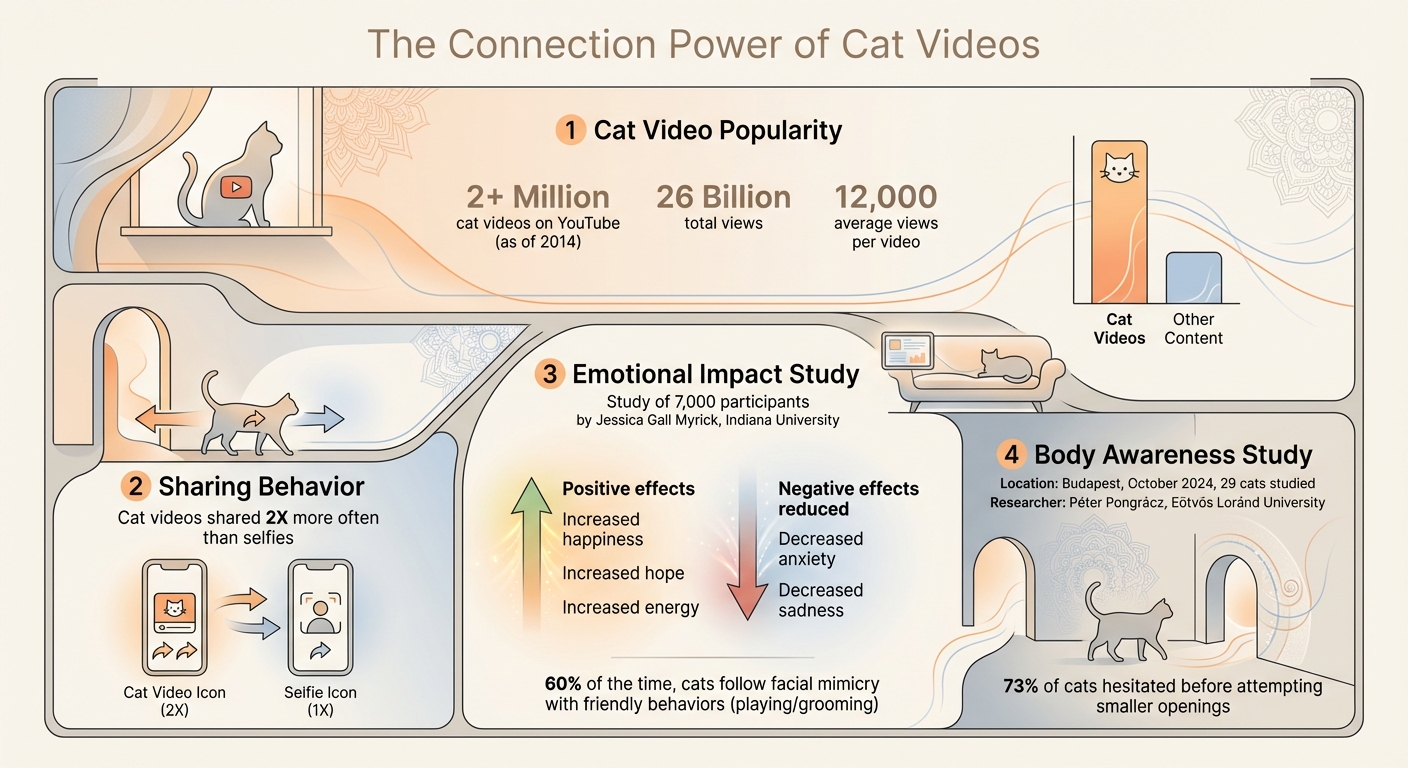
How Cats Connect Us: Statistics on Feline Impact on Human Connection
Cats, much like they bridge the spaces in our homes, also bridge hearts across the vast expanse of the internet. Cat videos are some of the most-watched and shared content online - not just because they’re adorable, but because they resonate with something deeper in us. Back in 2014, YouTube already hosted over 2 million cat videos, collectively amassing nearly 26 billion views. On average, each video received 12,000 views, outpacing other content categories on the platform.
A single cat video has the power to turn loneliness into laughter. Interestingly, people share cat videos more than twice as often as selfies. This isn’t about vanity - it’s about connection. Sharing a cat video isn’t just about entertainment; it’s about offering a small, joyful moment that transcends barriers of language, culture, and age. Each video passed along is like a little gift, reminding us of the same effortless connection we feel with cats at home, now extended to an online community.
Jessica Gall Myrick, an assistant professor at Indiana University’s Media School, conducted a study involving nearly 7,000 people who watched cat videos. Her findings showed that the emotional impact of these videos is both real and measurable. Participants reported feeling happier, more hopeful, and energized, while negative emotions like anxiety and sadness noticeably decreased. Myrick noted:
"Even if they are watching cat videos on YouTube to procrastinate or while they should be working, the emotional pay-off may actually help people take on tough tasks afterwards."
In every shared purr and playful leap, we’re reminded of our shared desire to connect. This universal appeal reflects how even the simplest moments - like watching a cat video - can foster a sense of belonging.
But this isn’t just a distraction; it’s a meaningful form of connection. Watching a cat slow-blink at the camera, purr softly into a microphone, or hilariously tumble off a couch can trigger oxytocin, the hormone linked to bonding, in our brains. It’s the same chemical reaction that happens when you pet your own cat, but now it’s happening across screens, in comment threads, and through shared laughter. These digital moments echo the quiet, comforting bonds we form at home, showing us that connection doesn’t require physical proximity - it just requires openness.
In a world where our online lives often feel like parallel tracks, cat videos remind us that joy can be simple and deeply shared. So why not join in? Share your favorite cat video today and celebrate the small, spontaneous connections that make life feel a little brighter.
sbb-itb-b6c1dc0
Keeping the Connection Alive
Real presence beats digital distractions every time. For over 10,000 years, cats have been part of our lives, and in that time, they've mastered the art of drawing our attention - especially when we're glued to screens or lost in books. That deliberate meow or gentle nudge? It's their way of pulling us back into the moment.
John Bradshaw, a Visiting Fellow at the University of Bristol School of Veterinary Sciences, captures this idea beautifully:
"Cats purr because they have something to say, which roughly translated is 'please keep still and pay attention to me.'"
That soft, steady purr isn't just background noise. It's a quiet invitation to pause, to share space, and to be present. These subtle cues can remind us to step away from the endless pull of digital life and refocus on what truly matters.
The slow blink, a tail held high, or even a quiet approach - these small gestures carry weight. They speak of trust, comfort, and connection. By noticing and responding to these moments, we can transform ordinary routines into meaningful exchanges, rooted in mindfulness and care.
A Moment for Reflection and Meaning
The call for presence doesn't have to stay at home - it can follow us into the world. A slow-blink design on a tote bag, or the silhouette of a tail-up cat on a hoodie, is more than just an aesthetic choice. These symbols act as reminders of the moments we share with our cats: the calm of a lap warmed by their trust, the quiet joy of their companionship.
Our selection of cat-inspired designs offers a way to carry these feelings with you. It's not just about wearing something cute; it's about holding onto the quiet truth that connection matters. These designs reflect a value you already live by: noticing and appreciating the small, meaningful things.
Wearing these symbols isn't about vanity - it’s about intention. It’s a way to outwardly express what you hold dear inside: the belief that the best connections are built on presence and simplicity.
In silence, the deepest bonds are formed. And in a world filled with constant noise and distraction, choosing to honor those quiet connections is a statement worth making. A single purr can speak louder than any words.
Conclusion: What Cats Teach Us About Connection
Cats don’t wait for permission to explore. They glide through our homes as if walls were suggestions rather than barriers. In their quiet, confident way, they remind us that the divisions we create - whether physical or emotional - can be softened, even erased, through simple acts. A single purr can bridge gaps words often fail to close.
Modern life often nudges us toward separation. We retreat into our own spaces, lose ourselves in screens, and follow individual routines. But as we’ve reflected, a cat sees the home as one seamless whole - a perspective that offers a gentle lesson on unity. They bring warmth and connection wherever they go, whether it’s through a slow blink from across the room, a soft paw on your lap, or the steady rhythm of their purring. Often, they’re beside us before we even realize we needed the comfort.
Connection doesn’t demand words or constant notifications; it grows through presence, patience, and trust. Cats mirror our emotions with a blink or a nuzzle - not to manipulate, but to bond. When they feel safe with us, they release oxytocin, the same chemical that deepens bonds between human parents, partners, and friends. These quiet exchanges of trust stand in stark contrast to the fleeting nature of digital communication.
In a world buzzing with endless distractions, a cat gently draws us back to what’s real. They remind us that the strongest connections are formed in silence, in shared spaces, and in the willingness to simply be present. For those who want to carry this quiet wisdom with them, our cat-inspired designs offer a simple way to hold onto what truly matters.
Just as two beings, separated by walls, can find comfort in a single nudge, we too can rediscover unity in our daily lives. The barriers we build don’t have to divide us. Sometimes, a small creature - moving freely, trusting deeply, connecting effortlessly - shows us how to find our way back to one another.
True connection doesn’t shout; it whispers, and its echoes linger.
FAQs
Why do cats move through the house like it’s one space?
Cats perceive their home not as a collection of separate rooms but as one unified space. This view stems from their strong territorial instincts and their innate need for a sense of freedom. They thrive on the ability to explore and observe their surroundings, which helps them feel secure. Their graceful, fluid movement from room to room highlights their natural curiosity and desire to maintain control over their environment. Even in homes with distinct boundaries or divided areas, cats treat the space as a single, connected domain where they can move freely and stay vigilant.
How can my cat help me and my partner feel more connected?
Your cat has a subtle way of bringing you and your partner closer, creating shared moments that feel both natural and meaningful. Cats have an uncanny ability to move seamlessly between physical and emotional spaces, reminding us that small, genuine interactions - like a soft purr or a gentle nuzzle - can strengthen relationships. In a world where routines often pull us in different directions, your cat’s quiet presence has a way of bridging gaps, fostering connection without the need for elaborate words or gestures.
What makes cat videos so comforting to share online?
Cat videos offer a special kind of comfort by showcasing real, unscripted moments that speak to our innate desire for connection. Cats have a way of closing both physical and emotional distances, reminding us of life’s simple pleasures - whether it’s the soothing sound of a purr or their quirky, playful behavior. These genuine glimpses into their world feel honest and pure, creating a shared sense of joy and lightheartedness. In a time when much of our communication happens through screens, these moments stand out, offering a refreshing pause from the fast-paced digital world.
Related Blog Posts


Leave a comment