

Have you ever caught your cat perched on the kitchen counter, staring at you as if daring you to react? One day she avoids it entirely, and the next, she’s right back up there, acting like the rules don’t exist. It’s easy to wonder if she’s testing your patience, but her behavior is far more thoughtful than it seems. Cats don’t follow rules out of obedience - they respond to the connection they feel with you and the safety of their surroundings.
In many ways, their actions are less about defiance and more about instinct and trust. Cats are independent by nature, yet they adapt to the rhythms and routines of the home they share with you. Their choices often reflect how secure they feel and the bond you’ve built together. Let’s take a closer look at why they follow some boundaries while ignoring others - and what it says about your relationship with them.
The Challenge: When Cats Seem to Ignore Boundaries
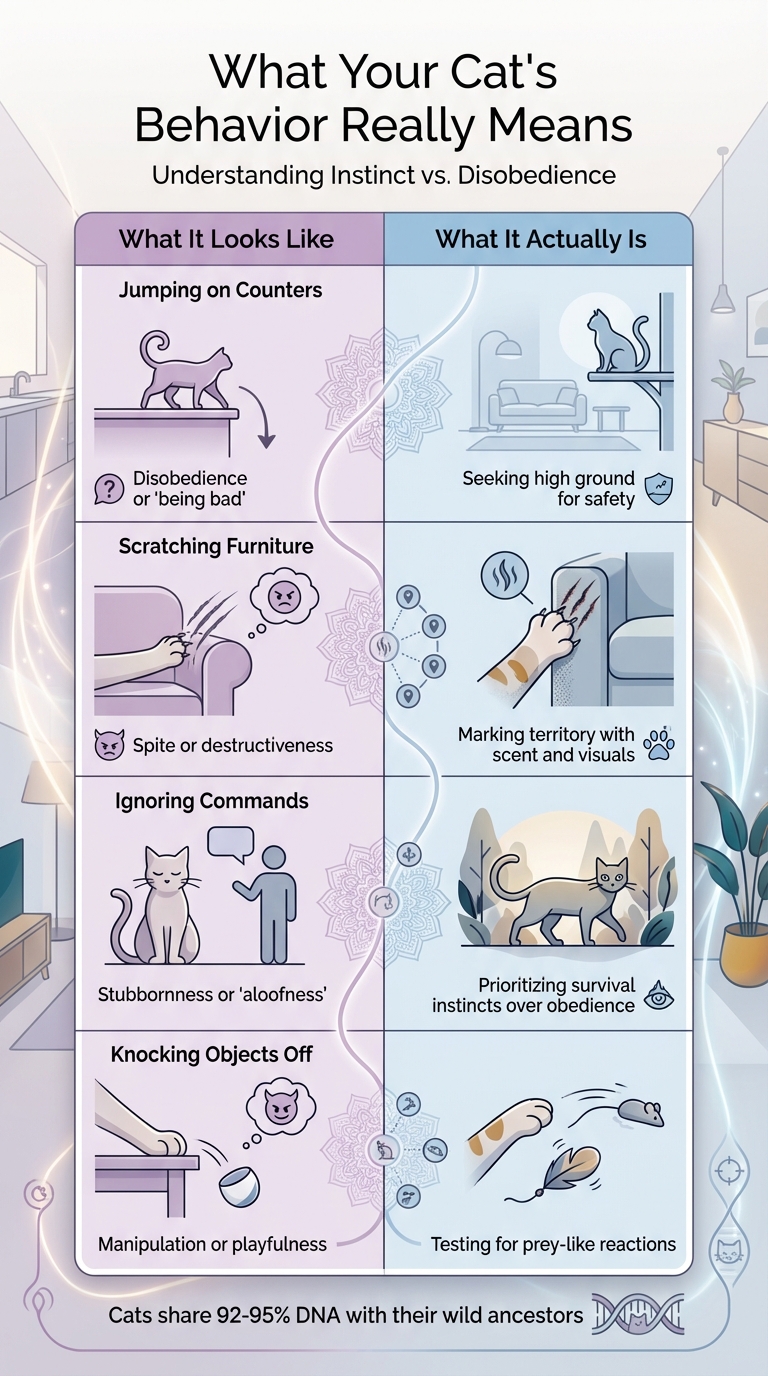
Cat Behaviors Decoded: What They Really Mean
You’ve laid down the rules - no jumping on the kitchen counter, no scratching the couch arm. Yet, there she is again, perched on the counter like it’s her personal throne or clawing at the couch as if it were meant for her alone. It might feel like she’s testing your patience, but her actions aren’t about defiance - they’re rooted in instinct.
Cats aren’t ignoring you out of spite. Their behavior is shaped by instincts that go back thousands of years. In fact, domestic cats still share 92–95% of their DNA with their wild ancestors. This means the habits that might frustrate you - jumping, scratching, or seemingly tuning you out - aren’t bad behavior. They’re survival strategies that have stood the test of time.
How Evolution Shaped Cat Independence
Cats didn’t evolve to work alongside humans like dogs did. Instead, they chose to coexist with us. About 10,000 years ago, wildcats began hanging around human settlements, attracted by the mice that thrived on stored grain. Humans tolerated their presence because they kept pests under control. Unlike dogs, no one bred cats to obey or to be part of a team. Cats essentially domesticated themselves, and that fierce independence still defines their every move today.
Dogs are descendants of pack animals that thrive on cooperation and hierarchy. Cats, on the other hand, evolved as solitary hunters who relied on their own instincts to survive. Dr. John Bradshaw from the University of Bristol explains this distinction:
Cats are descended from a solitary, territorial ancestor. Unlike dogs, cats place more reliance on the security of their territory than on psychological attachments to people.
When your cat leaps onto the counter, she’s doing what her ancestors did - seeking high ground for safety and a better view of her surroundings. Scratching the couch isn’t an act of rebellion; it’s her way of marking her territory, using the scent glands in her paws to claim the space. These behaviors aren’t about disobedience - they’re about survival and a deep-seated need for control and security.
Why 'Disobedience' Is a Misunderstanding
To understand your cat’s behavior, it helps to see the world through her eyes. Cats don’t interpret rules the way humans or even dogs might. They don’t view them as commands to follow but rather as challenges to their independence. Cats value autonomy above all else. Jackson Galaxy, a well-known cat behaviorist, sums it up perfectly:
Cats demonstrate love through presence, not obedience.
Unlike dogs, who often look to humans for guidance when faced with a problem, cats rely on their own resourcefulness. As John Bradshaw puts it:
If there’s a problem, cats try to solve it on their own. And if they fail, they just walk away.
This isn’t stubbornness - it’s self-reliance. Your cat isn’t ignoring you out of malice or indifference. Her powerful hearing allows her to detect frequencies up to 64 kHz (far beyond the human range of 20 kHz), but her brain is wired to prioritize sounds tied to survival, like the rustle of prey, over human voices. So when she seems to tune you out, it’s not personal - it’s instinct.
| Behavior | What It Looks Like | What It Actually Is |
|---|---|---|
| Jumping on Counters | Disobedience or "being bad" | Seeking high ground for safety |
| Scratching Furniture | Spite or destructiveness | Marking territory with scent and visuals |
| Ignoring Commands | Stubbornness or "aloofness" | Prioritizing survival instincts over obedience |
| Knocking Objects Off | Manipulation or playfulness | Testing for prey-like reactions |
When you understand these behaviors through the lens of instinct, it shifts your perspective. Your cat isn’t defying you - she’s responding to deep-rooted survival drives. Recognizing this is the first step toward creating an environment that works with her instincts rather than against them.
Why Cats Do Follow Rules: The Psychology Behind Compliance
“Cats don’t follow rules. They follow meaning.”
Cats might have a reputation for being independent and aloof, but they do follow rules - just not in the way we might think. Their compliance stems from emotional bonds, a sense of security, and their ability to read our cues. For them, it's less about obedience and more about trust, predictability, and the connection they've built with you.
How Cats Read Human Emotions
Cats are remarkably observant creatures. They watch your every move, paying close attention to your facial expressions, tone of voice, and body language. This skill, known as social referencing, helps them navigate uncertain or unfamiliar situations by looking to you for guidance.
One fascinating study found that 79% of cats alternated their gaze between a novel object - like a strange fan - and their owner to decide how to react. If their owner appeared calm and relaxed, the cat was more likely to approach the object. If the owner seemed scared, the cat kept its distance. Researcher Felicity Muth noted:
"The cats responded to the emotional response of their owner, being more likely to move away from the fan when their owner was looking scared."
This sensitivity extends beyond fear. Cats are attuned to a wide range of human emotions. For example, they may avoid approaching you when you're sad or react differently to high-energy, extroverted behavior. Your mood becomes a factor in their decision-making process. When you calmly and consistently set boundaries, your cat registers that stability. On the flip side, if you're anxious or unpredictable, she picks up on that too, and her behavior may reflect the uncertainty she feels.
Interestingly, cats also recognize their owner's voice. While they might not always come when called, they can distinguish your voice from a stranger's. As researchers Saito and colleagues explained:
"Cats recognize their owner's voice and can distinguish it from strangers... They're simply not programmed to come running."
This recognition is more than just a party trick; it's part of how cats create a mental map of their environment. They use these cues to determine what's safe, what to expect, and who to trust. This emotional attunement is a cornerstone of the bond that encourages them to respect boundaries.
Trust and Bonding Between Cats and Owners
At the heart of a cat's rule-following behavior is trust. Studies show that a secure attachment between cats and their owners lowers stress and promotes more predictable actions. When your cat feels emotionally safe, she's more inclined to respect the environment you've shaped together. The rules you set aren't seen as restrictions but as part of a stable, comforting routine.
Feline behaviorist Jenne Mundy from CatProfiler sums it up well:
"For a cat, truth isn't honesty. Truth is consistency."
Cats don't follow rules because they understand the concept of right and wrong. They do so because consistency makes them feel secure. For example, regular mealtimes, steady reactions, and a predictable routine can reduce a cat's cortisol (stress hormone) levels by nearly 50%. In this relaxed state, they're far more likely to respect the boundaries you've set.
On the other hand, punishment can erode trust and increase stress. Instead of learning the "rule", your cat may become anxious, leading to more unwanted behaviors like spraying, scratching, or hiding. Punishment doesn't teach compliance - it creates fear, making your cat feel unsafe and more reliant on instinct-driven actions.
The bond you share with your cat isn't based on commands or control; it's built on mutual understanding and consistency. When your cat slow-blinks at you, she's expressing trust. When she head-butts your hand or shows her belly, she's demonstrating vulnerability. These gestures aren't just signs of affection - they're part of the unique language of your relationship. Through this connection, rules become less about enforcement and more about mutual respect.
Some people start to recognize these small signals everywhere.
In the way their cat waits near a doorway.
In the way certain spaces feel “chosen.”
And sometimes, they carry that awareness beyond the home.
Behavior Patterns That Support Rule-Following
“What looks like disobedience is often just a different logic.”
Cats thrive when their natural instincts and rhythms are respected. Instead of trying to enforce strict rules, it's more effective to create an environment where good behavior comes naturally. This aligns with the idea that a stable home fosters trust and predictability, making boundaries easier for cats to understand and follow.
How Routine and Stability Affect Cat Behavior
Cats are creatures of habit, guided by natural cycles of light, sound, and routine. A consistent schedule helps them feel secure and encourages them to stick to predictable patterns.
Dr. Marci Koski, a Certified Feline Behavior and Training Consultant, explains:
I believe cats use daylight levels and natural sounds to help regulate their internal clocks... In our homes, this translates to cats wanting to play in the morning and evening.
To support this, align your cat’s activities - like feeding and playtime - with her natural cycle of hunting, eating, grooming, and resting. For example, feeding her at the same time each morning, followed by a play session, allows her to groom and relax afterward, mimicking her instinctual rhythm.
Laura Cassiday, a Certified Cat Behavior Consultant, adds:
Research shows cats have internal clocks that help them anticipate events and establish routines.
When dinner consistently arrives at 7:00 p.m., your cat won’t beg for food hours earlier. Similarly, if you engage her in play before bedtime, she’s less likely to zoom around the house at midnight. Consistency is a form of communication. It reassures your cat that her environment is stable and that you’re dependable.
Many behavioral issues - like scratching furniture, knocking items off counters, or waking you up at odd hours - stem from boredom or stress rather than disobedience. Enriching your cat’s environment and maintaining a predictable routine can lower stress-related behaviors significantly. Studies show that such changes can reduce symptoms of stress-related illnesses in cats by as much as 75–80%.
Setting Up Your Home to Guide Cat Behavior
The way your home is arranged plays a big role in shaping your cat’s behavior. Cats are territorial by nature, as Dr. John Bradshaw points out:
Cats are descended from a solitary, territorial ancestor. Unlike dogs, cats place more reliance on the security of their territory than on psychological attachments to people or other cats.
When a cat feels her territory is safe and well-organized, she’s more likely to use it appropriately.
To reduce competition and anxiety, follow the n+1 rule: provide one more resource - like litter boxes, food bowls, and scratching posts - than the number of cats in your home. For instance, if you have two cats, set up three of each resource. This approach ensures that each cat has access to what she needs without feeling threatened. A private, easily accessible litter box is more likely to be used, and scratching posts placed near doorways or sleeping areas align with your cat’s natural desire to mark her territory.
Vertical space is another key factor. Cats feel safer and more in control when they can observe their surroundings from above. Adding elevated perches or cozy hideaways gives them the opportunity to retreat and relax. Enclosed spaces like cardboard boxes or tunnels also appeal to their instinct for thigmotaxis - the comfort of being in close contact with surfaces - which can help keep them away from off-limit areas.
Even scent plays a role in creating a secure environment. Cats mark safe zones by rubbing their cheeks on surfaces, leaving behind scent markers. Avoid using harsh cleaners on these areas, as it can disrupt their sense of ownership. When a cat feels confident that a space is hers, she’s less likely to engage in unwanted behaviors like spraying or scratching furniture.
For your cat, your home is her entire world. By arranging it to align with her natural instincts, you’re not just setting boundaries - you’re creating a space where she feels secure, content, and naturally inclined to follow the rules.
sbb-itb-b6c1dc0
How to Set Boundaries Cats Will Actually Respect
Understanding your cat's natural habits and environment is just the beginning. The real challenge lies in setting boundaries in a way that makes sense to her - without creating stress or confusion. Unlike dogs, cats don’t follow rules out of loyalty or a desire to please. They need clear, consistent communication that aligns with how they naturally think and learn.
The key is to work with your cat’s instincts rather than against them. Punishing a cat doesn’t teach her what you want; it only creates fear and damages trust. Instead, boundaries are best established through positive reinforcement - rewarding behaviors you like and calmly ignoring the ones you don’t. By being consistent, you not only set limits but also build a foundation of trust that strengthens your bond.
Using Rewards to Encourage Good Behavior
Cats learn through association, but timing is everything. For a reward to be effective, it must be given within half a second of the desired behavior. Any delay, and your cat won’t connect the reward to her action.
Clicker training is an excellent tool for marking the exact moment your cat gets it right. A 2022 study at Tufts University compared methods for teaching cats to "sit." The group using clicker training - where a distinct sound signals a reward - had an 89% success rate, while the group relying solely on voice commands achieved only 11%. The clicker acts as a clear signal, helping your cat understand what she did to earn the treat.
The type of reward matters too. Cats are more motivated by soft, flavorful treats like canned food, meat pastes (such as Churu), or tiny bits of cooked chicken than by dry kibble. Pair these treats with high-pitched sounds - like "kissy" noises or whistles - which cats tend to find more engaging than lower, deeper tones.
Mikel Delgado, a Postdoctoral Fellow at the University of California, Davis, sums it up well:
Reward what you like and ignore what you don’t like.
For example, if your cat jumps on the counter and you respond with loud shooing or scolding, you might unintentionally make the behavior more exciting. Instead, gently remove her without a fuss, then reward her when she stays on the floor. Over time, she’ll learn where the rewards are.
Keep training sessions short and sweet - no more than five minutes, two to three times a day. It’s best to train before meals when your cat is naturally more focused and motivated. Sarah Ellis, co-author of The Trainable Cat, advises:
The most common mistake people make when training cats is to ask for too much too soon.
Break big goals into small steps. If you’re introducing her to a carrier, start by rewarding her for sniffing it, then for stepping inside, and finally for staying calm when the door is closed.
When ignoring unwanted behaviors, be prepared for an “extinction burst.” This happens when a behavior - like meowing for food at 3:00 a.m. - initially gets worse before it fades. Your cat may try harder to get your attention, but if you stay consistent and don’t give in, she’ll eventually stop.
In addition to rewards, respecting your cat’s independence plays a big role in setting boundaries she’ll accept.
Balancing Rules with Your Cat's Need for Independence
Cats value what behaviorists call "territorial sovereignty" - the ability to control their space and make choices within it. If you force interactions or restrict access to places she sees as safe, it can lead to stress and even amplify the behaviors you’re trying to curb.
The solution isn’t to remove all boundaries but to create ones that respect her need for autonomy. For example, instead of blocking off an entire room, provide her with two acceptable options for where she can go. Offer multiple feeding spots, cozy hideouts, and scratching posts so she feels in control of her choices. This approach reduces defiance because she’s not in a constant battle for access - she’s simply picking what works best for her.
If you want to keep her off the counter, don’t just scold her for jumping up. Offer a more appealing alternative, like a perch nearby where she can still observe the action. Daily play sessions - especially with wand toys - can also help. Studies show that just 15 minutes of play a day can reduce unwanted scratching by 73%, as it satisfies her hunting instincts in a way that aligns with your household rules.
Jackson Galaxy, a Certified Cat Behaviorist, reminds us:
Cats demonstrate love through presence, not obedience.
When your cat ignores a rule, it’s not an act of rebellion. She’s simply navigating her world in the way that feels safest and most natural to her. By setting boundaries that honor her independence while guiding her toward acceptable behaviors, you create a relationship rooted in trust, not control.
Even something as simple as teaching name recognition can strengthen this bond. When consistently paired with high-value treats, name recognition has a 90% success rate. Teaching her to come when called isn’t about enforcing obedience - it’s about building a positive connection to your voice. Over time, these small moments of cooperation add up, creating a relationship where she chooses to follow the rules because they make her feel secure and valued.
Building a Relationship Based on Trust
Setting boundaries with your cat isn't about exerting control - it's about creating a shared understanding in a way she instinctively gets. When she knows what to expect from you, and you learn to interpret her signals, the dynamic shifts from correction to partnership. Trust grows not from obedience but from consistency, mutual respect, and the gradual understanding that develops over time. This trust becomes the cornerstone of a deeper connection.
Interestingly, cats form attachment bonds that resemble those of human infants. Many domestic cats show secure attachment to their owners, meaning they see you as more than just a provider of food - they view you as a source of comfort and safety. When you respond predictably to her needs and respect her boundaries, you become her "secure base", a concept researchers use to describe someone who makes the world feel safe.
Building this trust doesn't happen overnight. It's built through everyday actions: feeding her at regular times, respecting her need for space, and staying calm when she's uncertain. Dr. John Bradshaw, an expert in human-animal interaction, explains:
Cats are descended from a solitary, territorial ancestor. Unlike dogs, cats place more reliance on the security of their territory than on psychological attachments to people or other cats.
In other words, your cat's trust in you is closely tied to how safe and predictable her environment feels. By responding consistently and respectfully, you create a space where she feels secure and connected.
Creating Mutual Respect Through Understanding
Once trust is established, mutual respect follows when you learn to read your cat's subtle cues. When she seems to ignore a rule, it's not stubbornness - she's communicating her needs or comfort level. Cats, with their 276 distinct facial expressions and 26 muscle movements, can convey a surprising range of emotions. About 46% of these expressions are considered friendly, offering plenty of opportunities to understand her better.
One of the simplest yet most meaningful signs of trust is the slow blink. When a cat slow blinks, she's signaling that she feels safe. You can return the gesture to show her you feel the same. Research from the University of Sussex has found that cats are more likely to approach humans who initiate slow blink exchanges. It's a quiet, shared moment that says, "I trust you."
Other behaviors also reveal her feelings. A tail held straight up is a friendly greeting, showing recognition and fondness. When she rubs against you (a behavior known as allorubbing), she's blending her scent with yours, marking you as part of her world. Kneading, or "making biscuits", is a leftover behavior from kittenhood that indicates contentment. And when she exposes her belly, she's showing you the most vulnerable part of her body, a strong sign of trust.
By understanding these signals, you can respond in ways that strengthen your bond. For example, if she flicks her tail or flattens her ears, it's a sign to stop what you're doing. Respecting these boundaries shows her you're listening, reinforcing her sense of control in your interactions. Over time, this mutual respect creates a natural cooperation between you.
Jenne Mundy, a feline behaviorist, sums it up perfectly:
For a cat, truth isn't honesty. Truth is consistency.
When your actions are consistent, your cat learns to trust you. And when she trusts you, she's more likely to respect the boundaries you've set - not because she has to, but because she feels secure within them.
Celebrating the Bond Through Symbols and Shared Spaces
The routines you share with your cat carry more emotional weight than you might think. Feeding her at the same time each day, greeting her in the morning, or setting aside time for play in the evening - these small rituals become the fabric of your relationship. They're not just habits; they're a language of connection.
Shared spaces also play a role in this bond. Instead of pushing her off the counter, offer her a perch nearby where she can watch you cook. If she loves to be close, set up a cozy spot on your desk or a blanket on the sofa so she can stay near without being in the way. These compromises balance her need for closeness with your need for space, deepening the connection between you.
Cats are observant creatures and often adapt to your routines. She might follow you to the bathroom, sit beside you while you work, or wait by the door when you're due home. These behaviors aren't random - they're her way of aligning her world with yours. A 2019 study even found that a cat's behavior often mirrors her owner's personality and caregiving style. If you're calm and consistent, she's likely to reflect that.
Some people choose to honor this bond through symbolic gestures, like wearing cat-themed designs, dedicating a special space in their home to their cat, or simply acknowledging the emotional depth of their relationship. These acts aren't about the objects themselves but about recognizing the value of the connection you share.
Jackson Galaxy, a certified cat behaviorist, reminds us:
Cats demonstrate love through presence, not obedience.
When your cat chooses to stay near you, follow your routines, or respect your boundaries, it's not out of obligation. It's because she feels safe and secure with you. And that's what truly forms the foundation of your relationship.
If you’ve started noticing these patterns, you’re already seeing your cat differently.
Not as “disobedient” —
but as someone moving through a space that matters.
We design pieces for people who notice that kind of connection.
Conclusion: What Cat Behavior Teaches Us About Connection
When your cat chooses to follow a rule, it’s not out of obligation but a reflection of trust and the sense of security she feels in the environment you’ve created together. Cats, retaining 95% of their wild instincts, are fully capable of living independently. This makes their moments of cooperation all the more meaningful - they’re acts of choice, not submission.
What’s even more striking is that many cats form secure attachment bonds with their humans. To your cat, you’re not just a provider of food; you’re her anchor, the one who makes her world feel stable and safe. When she respects a boundary or adheres to a routine, it’s her way of showing that she feels comfortable enough to let her guard down.
This willingness to cooperate stems from a relationship built on mutual trust and consistency. It highlights an important truth about the connection we share with our feline companions: they don’t follow rules to gain approval. They do so because predictability brings comfort, routines ease anxiety, and the trust you’ve nurtured makes these interactions feel natural. In a world where many relationships are transactional, the bond between humans and cats offers something quieter, more genuine.
Dr. Jon Bowen captures this sentiment perfectly:
Cats are not small dogs, and they are not furry humans... they cooperate with humans on their own terms.
And that’s the beauty of it. Your cat isn’t compelled to stay or show affection - she chooses to. That choice speaks volumes about the bond you’ve built together. She has chosen you, just as much as you’ve chosen her.
FAQs
How can I keep my cat off counters without punishment?
To discourage your cat from jumping on counters without resorting to punishment, focus on making the counters less attractive while offering better alternatives. Start by clearing counters of food and other tempting items that might draw their attention. Cats love to climb, so providing tall, secure perches or cat trees can satisfy this instinct. Encourage your cat to use these spaces by rewarding them with treats or affection when they choose the perch over the counter.
Avoid using punishment, such as yelling or spraying water, as these methods can create fear and damage trust without addressing the behavior effectively in the long run. Positive reinforcement and creating appealing alternatives are much more effective strategies.
Why does my cat follow some rules but ignore others?
Cats seem to pick and choose which rules to follow, and this often comes down to their instincts, survival needs, and personal preferences. They’re more likely to respect boundaries that align with their natural tendencies, such as their territorial instincts. On the other hand, commands or rules that don’t connect to their safety or innate behaviors are often ignored.
Their sharp senses also influence this. Cats are especially tuned in to sounds or signals that relate to survival, which means their behavior isn’t about being stubborn or disobedient - it’s more about instinct and their unique way of communicating.
What’s the fastest way to teach a cat new boundaries?
Teaching a cat boundaries works best when you focus on consistent rules and use positive reinforcement. If your cat crosses a boundary, avoid giving them attention - even scolding can feel like a reward to them. Instead, gently guide them toward acceptable behaviors and reward them when they comply. Cats are naturally territorial, so understanding their instincts and maintaining consistency will help them learn more effectively.


Leave a comment