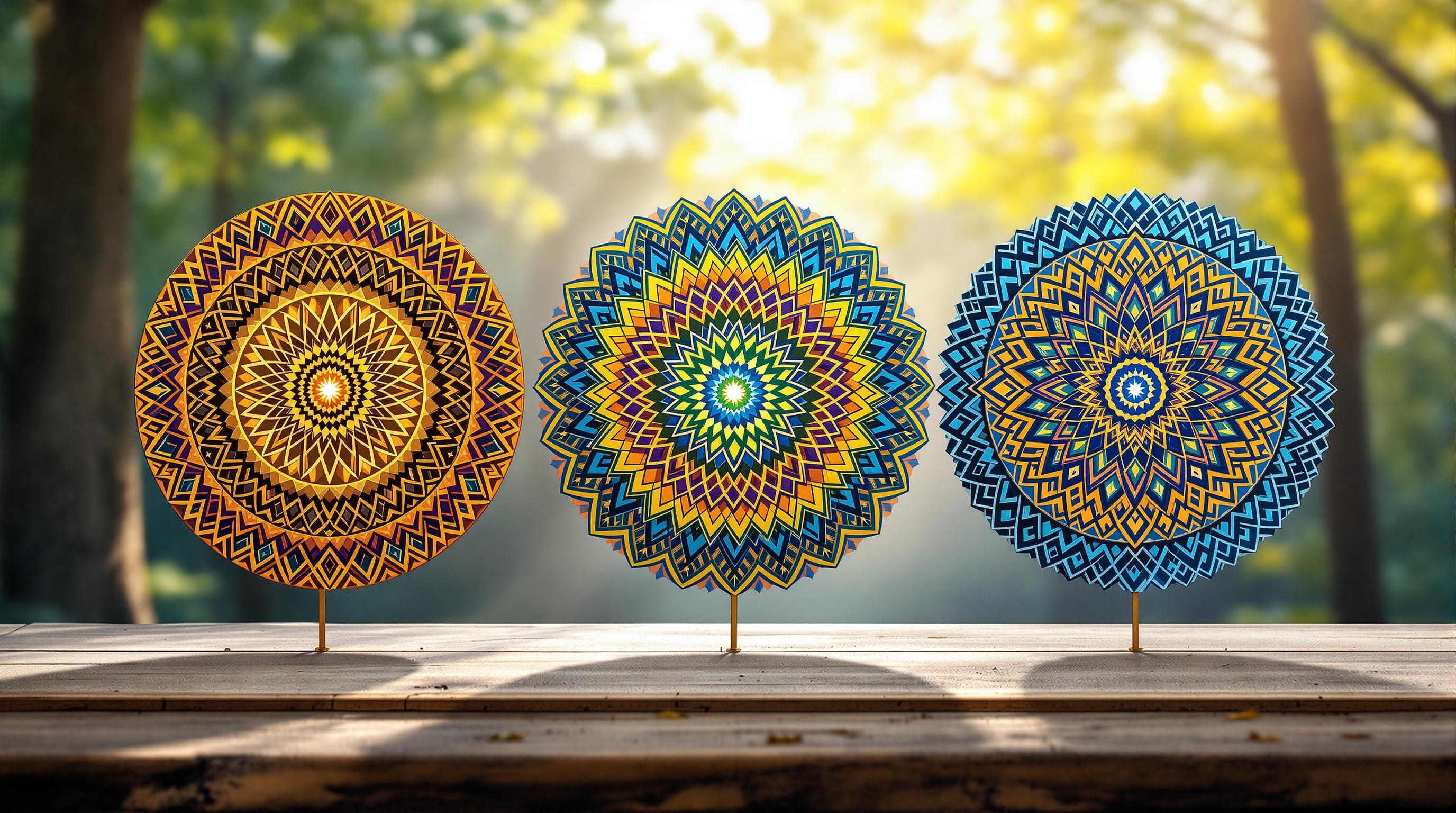
Mandalas are circular designs used in meditation, spirituality, and art across cultures. Here's a quick breakdown of their unique features:
- Buddhist Mandalas: Focus on precise geometry and cosmic symbolism. Often made with sand, they emphasize impermanence and aid meditation. Colors like white (purity) and red (strength) hold specific meanings.
- Hindu Mandalas: Feature vibrant colors and sacred geometry, often centered around a deity. Used in rituals and temples to represent cosmic balance.
- Native American Medicine Wheels: Built with stones, these grounded designs reflect nature's cycles. They symbolize spiritual lessons tied to the four cardinal directions.
Each tradition offers a unique perspective on balance, meditation, and connection to the universe.
Quick Comparison:
| Mandala Type | Key Design Elements | Primary Purpose |
|---|---|---|
| Buddhist | Precise geometry, cosmos | Meditation, teaching |
| Hindu | Vibrant colors, nature | Divine connection |
| Native American | Earth tones, circular forms | Healing ceremonies |
These sacred designs, while different, share a focus on symmetry and mindfulness, bridging ancient traditions with modern wellness practices.
What Are Mandala Patterns?
1. Buddhist Mandala Patterns
Buddhist mandalas symbolize the universe and serve as spiritual tools, featuring distinct geometric designs. These patterns often follow a square-and-circle layout with four gates aligned to the cardinal directions.
Tibetan sand mandalas are known for their diverse purposes:
- Meditation Aid: The detailed designs help focus the mind during meditation.
- Teaching Tool: The symbols within the mandala convey key Buddhist teachings.
- Sacred Offering: The temporary nature of sand mandalas highlights the concept of impermanence.
One of the most striking characteristics of Buddhist mandalas is their precise geometric design. The structure typically radiates outward from a central point, featuring layers such as a central deity, patterns representing enlightenment, and outer protective symbols.
The colors used in Buddhist mandalas hold specific meanings:
| Color | Meaning | Common Usage |
|---|---|---|
| White | Purity and wisdom | Central areas and deities |
| Blue | Infinity and healing | Sky elements and medicine |
| Red | Life force and strength | Fire elements and power |
| Green | Balance and harmony | Nature elements and peace |
| Yellow | Learning and prosperity | Earth elements and wealth |
Buddhist mandalas stand out for their symmetry and precise geometry, reflecting the cosmic order. This structured approach sets them apart from the more organic designs seen in other traditions.
Creating a Tibetan sand mandala is a meticulous process that can take weeks, involving coordinated efforts from multiple monks. After completion, the mandala is ceremonially destroyed to emphasize the Buddhist principle of non-attachment.
While modern practices have introduced digital tools for planning and designing mandalas, the core principles of sacred geometry and spiritual symbolism remain intact. This adherence to precision contrasts with the more fluid designs of Hindu mandalas, which will be explored next.
2. Hindu Mandala Designs
Hindu mandalas are rich in sacred geometry, featuring concentric shapes like squares, circles, and triangles. At the center, a deity often represents cosmic order, tying the design to spiritual balance. These mandalas are brought to life with vibrant colors, each chosen to channel specific energies and enhance meditation practices. Historically, they have been used in rituals and temples as visual representations of the universe's structure. Today, brands like Blululi (https://blululi.com) have reimagined these designs, incorporating their timeless beauty into everyday items for mindful living.
sbb-itb-b6c1dc0
3. Native American Medicine Wheels
Native American Medicine Wheels, unlike the intricate Hindu mandalas, feature a grounded, stone-based design deeply connected to indigenous spirituality. These sacred structures are crafted on the earth using carefully arranged stones.
The design of a Medicine Wheel typically includes a central stone hub with radiating spokes that divide the circle into sections. The four cardinal directions - North, South, East, and West - form the foundation, each associated with specific natural elements, seasons, and spiritual lessons. This layout provides the framework for rituals tied to the rhythms of nature.
Key elements of a Medicine Wheel include:
- Center Stone: Represents the Creator and the origin of life.
- Cardinal Points: Larger stones symbolizing distinct spiritual qualities.
- Outer Circle: Stones marking the continuous cycle of life.
Medicine Wheels serve a variety of ceremonial purposes, from healing rituals to tracking astronomical events. For example, the Bighorn Medicine Wheel in Wyoming is known for its alignment with key celestial occurrences, including the summer solstice.
These wheels are simple in design, reflecting a respect for natural materials. The stones remain unaltered, celebrating their connection to the earth, in contrast to the intricate patterns of Hindu and Buddhist art.
Many Native American communities still incorporate Medicine Wheels into their spiritual practices today. At Moose Mountain in Saskatchewan, Canada, for instance, these wheels are used in ceremonies where participants walk clockwise around the circle. At each direction, they pause to reflect on its teachings and seek spiritual understanding. This active, physical engagement contrasts with the meditative focus of mandalas in Asian traditions.
Medicine Wheels continue to hold deep spiritual importance, and many remain active ceremonial sites. Access to some, like the Moose Mountain Medicine Wheel, is often restricted to honor their sacred significance and to preserve their role in traditional rituals.
Comparing Key Features
Mandalas have long been used in Buddhist, Hindu, and Native American traditions as tools for meditation. These intricate patterns originally played a role in cultural rituals focused on mindfulness. Over time, their purpose has expanded, blending their spiritual roots with modern approaches to well-being.
Take Blululi, for instance. They incorporate mandala designs into lifestyle products like tote bags (starting at $23.00) and wall clocks (priced at $51.00 as of March 2025), bringing traditional art into everyday wellness routines.
Today, mandalas are used in various ways, including art therapy, digital meditation apps, home décor, and personal mindfulness practices. They offer a bridge between ancient traditions and modern mindful living.
Summary
Mandalas bring together a variety of artistic and spiritual traditions. Buddhist mandalas focus on precise geometry and cosmic symbolism, Hindu designs highlight vibrant colors and nature-inspired patterns, and Native American medicine wheels incorporate earthy tones and circular forms to reflect their connection to the natural world.
Over time, these timeless designs have adapted to modern contexts. Despite their varied origins, these mandala styles share core principles like symmetry, sacred geometry, and a focus on meditation. Today, many modern designs blend traditional elements with current wellness practices.
| Mandala Type | Key Design Elements | Primary Purpose |
|---|---|---|
| Buddhist | Precise geometry, cosmos | Meditation, teaching |
| Hindu | Vibrant colors, nature | Divine connection |
| Native American | Earth tones, circular forms | Healing ceremonies |
This rich variety of mandala designs offers endless possibilities for meditation and creative expression. Mandalas remain a powerful tool for fostering focus, sparking creativity, and cultivating a sense of inner calm. Ancient symbolism continues to play a meaningful role in today’s mindfulness practices.