

Cats quietly transform houses into homes through their presence and habits. They create emotional connections and establish favorite spaces - like sunny windowsills or high perches - that bring comfort and security. Their movements link rooms, turning separate spaces into a unified territory. Subtle gestures, such as purring or slow blinks, deepen bonds with their humans, offering calm and trust. Cats also help ground daily routines, from feeding times to shared play, reminding us to slow down and live in the moment. Through these quiet yet powerful interactions, cats weave a sense of belonging and warmth into every corner of a home.
How Cats Link Different Areas of Your Home
Cats have an extraordinary way of turning a house into a unified space, not just through their quiet companionship but also through how they move and choose where to be. Their presence doesn’t just fill a room - it connects the entire home, creating a sense of flow and continuity that goes beyond walls and doorways.
Unlike humans, who often see each room as having a distinct purpose, cats view your home as a single, connected territory. Researchers describe this as a "home range", an invisible map of spaces they frequent throughout the day. By moving between these areas, your cat transforms what might feel like separate rooms into a cohesive, living environment.
Moving Between Rooms Without Barriers
Cats naturally erase boundaries between rooms through their movement. They’re highly attuned to subtle environmental shifts, such as changes in warmth, light, or airflow - factors we might barely notice. A sunlit corner in winter or a cool tile floor in summer becomes an important stop on their daily rounds.
Interestingly, studies show that male cats tend to explore more rooms than females, creating broader connections within the home. In one study of 14 indoor cats living in a 1,300-square-foot house, kittens were the most adventurous, exploring every room, while adult cats developed more selective patterns. Social dynamics also play a role, as interactions with other cats can influence how they claim and connect different areas.
This movement isn’t random. Cats often navigate vertically, climbing bookshelves, cabinet tops, or even the backs of sofas. These elevated spots allow them to observe multiple areas at once, giving them a sense of security and control. This habit of surveying and mapping creates natural pathways that link different parts of your home.
Choosing Common Areas for Rest and Play
When your cat chooses to lounge in the living room instead of retreating to a quieter bedroom, it’s rarely by chance. Shared spaces often offer a mix of warmth, elevation, and a clear view of household activity - things cats find irresistible. These communal areas become focal points where your cat blends its personal space with the family’s most active zones.
In homes with multiple cats, favorite spots are often shared, but not simultaneously. Instead, cats take turns using prime locations throughout the day, avoiding conflicts while still enjoying the same space. This rhythm of shared use subtly links the cats to each other and to the home as a whole.
Cats’ preference for warmth, with an ideal temperature around 86°F, often draws them to sunny spots or furniture that holds heat. Through their choices of where to rest, play, or simply observe, cats weave the different rooms of your home into a single, interconnected environment. Their movements and habits remind us how even the smallest creatures can bring a sense of unity to the spaces we share.
Building Emotional Connections Through Quiet Presence
Cats have a remarkable way of forming deep bonds through the smallest, quietest gestures. A slow blink from across the room, the rhythmic kneading of their paws on your lap, or simply choosing to nap nearby - these understated moments weave a connection that feels deeply personal.
Unlike pets that might demand attention, cats offer companionship that’s calm and unobtrusive. This reserved nature is actually a sign of trust and respect. When a cat chooses to stay close instead of retreating to a secluded spot, it’s making a deliberate choice to share its space with you. Experts often note that the strongest bonds develop when you allow the cat to approach you on its own terms. This approach fosters a relationship built on mutual respect and quiet understanding.
How Purring Reduces Stress and Creates Calm
A cat’s purr is more than just a sound of contentment - it has a profound effect on the emotional energy of a home. With frequencies ranging between 25 and 150 Hz, purring has been linked to physical benefits like improved bone density, reduced inflammation, and even healing. For the cat, it’s a self-soothing mechanism, but for you, it’s a natural stress reliever that can help lower cortisol, the hormone linked to stress.
Each cat’s purr is unique, described by researchers as a "vocal fingerprint" that stays consistent throughout their life. This familiar sound becomes a comforting part of your daily routine, signaling safety and calm. You might even find yourself using the steady rhythm of their purring as a mindfulness tool - letting its vibrations guide your breathing during tense moments. It’s a quiet reminder of the soothing support they offer, simply by being near.
When Silence Speaks: Cats as Emotional Support
Sometimes, silence holds the most meaning. When a cat lies on its back, belly exposed, it’s showing complete trust - a vulnerable position they only assume when they feel utterly safe. Similarly, when your cat chooses to sit quietly beside you during tough times, that silent presence can feel profoundly grounding. They aren’t there to solve problems or offer advice; they’re simply there. And in that simplicity lies their strength.
This quiet companionship becomes even more valuable during moments of stress. Cats are incredibly attuned to changes in their surroundings, and their calm presence can act as a stabilizing influence. When they rub their head against you, they’re marking you with their scent - a way of including you in their social group. It’s their unspoken way of saying, “You belong to me, and I belong to you.” These small, wordless gestures create a bond that feels both enduring and comforting, built on shared presence and trust.
Cats as Guides to Mindfulness and Daily Routines
What Cats Represent in Daily Life
Cats seem to have an innate ability to live in the moment, a skill many of us find elusive. Their experience of time is fleeting, often limited to just a few seconds, which keeps them rooted in the now. Without even trying, they become gentle reminders for us to pause, breathe, and focus on what's right in front of us, free from distractions.
When your cat meows persistently, it’s not just about getting fed or being petted - it’s a way of pulling you back into the present. John Bradshaw, a Visiting Fellow at the University of Bristol School of Veterinary Sciences, explains:
"House cats learn that meowing is a good way of getting our attention: our pet felines often find that we have our noses buried in a book or a screen, so they meow to get us to acknowledge them."
Though it might feel like an interruption, that meow is a subtle invitation to reconnect with your surroundings. In those moments, your cat becomes a quiet guide, helping you step out of your thoughts and into your immediate environment. This sense of mindfulness naturally weaves into the rhythms of daily life.
Daily Routines That Ground Your Day
Cats thrive on predictability, and their routines often bring structure to the household. Their need for consistency creates natural anchors in your day, offering a sense of stability for both you and your feline companion.
Take feeding times, for example. Preparing your cat’s meals and sharing in their anticipation creates a shared ritual, grounding your day in a simple but meaningful act. Playtime is another way cats encourage mindfulness. When you move a wand toy or toss a crinkly ball, you’re not distracted by emails or chores - you’re fully present, watching your cat’s focused movements and playful energy. It’s a moment of pure connection, free from the usual rush of multitasking.
Even grooming sessions become opportunities for mindfulness. As you brush your cat, you’re attuned to their subtle signals - a flick of the tail, flattened ears - that tell you when they’ve had enough. These small, recurring interactions may seem ordinary, but they form a steady rhythm that brings calm and connection to your daily life. Through these routines, cats not only find comfort but also remind us of the beauty in slowing down and being present.
sbb-itb-b6c1dc0
Research on How Cats Affect Home Atmosphere
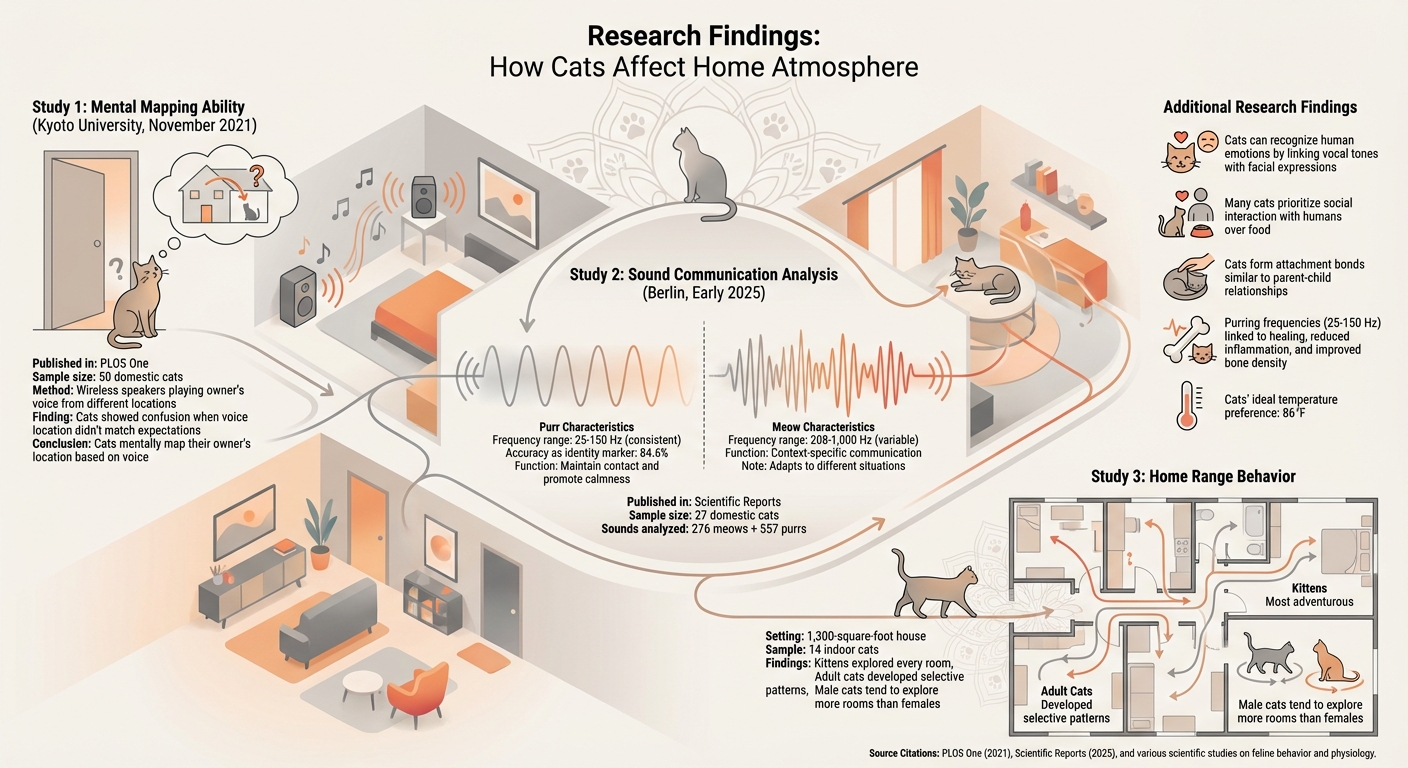
How Cats Transform Homes: Key Research Findings and Statistics
Scientists are delving into how cats shape the emotional tone of a home, revealing fascinating insights into their cognitive and social abilities. In November 2021, Saho Takagi and her team at Kyoto University conducted a study, published in PLOS One, involving 50 domestic cats from private homes and cat cafés. The researchers used wireless speakers to play recordings of an owner’s voice from different locations. The cats showed visible signs of confusion, suggesting they keep a mental map of their owner’s whereabouts, even when the person is out of sight.
Dr. Saho Takagi explained:
"This study shows that cats can mentally map their location based on their owner's voice. [It suggests] that cats have the ability to picture the invisible in their minds. Cats [may] have a more profound mind than is thought."
This discovery not only highlights their advanced cognitive skills but also hints at how cats contribute to the emotional fabric of a household. By tracking their owner’s presence, cats create a subtle but constant connection, reinforcing their bond with the people they live with. Additionally, research shows that cats can recognize human emotions by linking vocal tones with facial expressions, distinguishing feelings like anger or happiness. Interestingly, many cats prioritize social interaction with humans over food, emphasizing their role as emotional companions.
Further studies have explored how cats communicate through sound. In early 2025, a study published in Scientific Reports analyzed 276 meows and 557 purrs from 27 domestic cats in Berlin. The findings revealed that purrs, which occur at a consistent frequency of 25–30 Hz, serve as stable identity markers with an accuracy of 84.6%. Meanwhile, meows, ranging from 208 to 1,000 Hz, adapt to specific contexts, allowing cats to tailor their communication. As noted in the study:
"In cat–human communication, purring is used to maintain contact and promote calmness, as in cat–cat interactions."
Research into attachment behaviors further supports the idea that cats form bonds with their owners similar to the connection between a parent and child. These bonds go beyond mere curiosity, reflecting a survival instinct to stay close to their caregiver. Through their presence, vocalizations, and emotional awareness, cats subtly shape the atmosphere of a home, creating a sense of comfort and connection.
Conclusion: How Cats Turn Houses Into Homes
A house becomes a home when it holds more than walls and furniture - it’s when it carries the quiet threads of connection, trust, and shared presence. Cats have a way of weaving these threads effortlessly, transforming ordinary spaces into places of comfort and belonging. By marking their favorite spots, they create a kind of living map, a pattern of safety and connection that brings structure and warmth to every room.
But it’s not just about the physical space. Cats bring an emotional depth to our homes that’s easy to overlook. For example, domestic cats often develop unique "languages" of meows tailored specifically for their human companions - something rarely observed in feral cats. Their purring, with its gentle vibrations, creates a soothing environment that can ease the stress of daily life. It’s as if their presence alone softens the edges of a hectic world.
Giving cats the freedom to claim and control parts of their environment strengthens the trust between you. When a cat feels secure in its territory, it’s a sign of mutual respect, and this trust becomes a cornerstone of your shared life. Albert Einstein once reflected on this idea, noting how his cat Tiger provided him with a much-needed escape from the demands of the day. Similarly, a heartwarming story from 2026 about a rescued calico named Aya showed how deeply these bonds can run - Aya chose to sleep on a dog’s chest, a moment that perfectly captured how trust and connection can turn any shared space into a sanctuary.
Even the smallest corners of a home take on new meaning when a cat is part of the picture. A sunny windowsill becomes a haven of warmth and reflection, while high perches satisfy their need to observe and feel secure. These little pockets of comfort aren’t just for the cat - they remind us to slow down and appreciate the details that make a space feel alive and welcoming.
FAQs
Why does my cat roam the house on a “route” each day?
Cats tend to stick to particular daily routes within their homes, creating patterns that bring them a sense of security and control. By following these familiar paths, they can patrol their territory, move between favorite spots, and maintain a sense of routine. Their impressive spatial memory plays a key role here, allowing them to navigate these routes instinctively. This habit transforms the home into a space that feels stable and reassuring for them.
How can I strengthen our bond without forcing attention?
Creating a stronger bond with your cat starts with providing a peaceful and secure environment. Cats naturally gravitate toward spaces where they feel safe - often quiet corners or enclosed spots they’ve chosen themselves. Instead of forcing interaction, let your cat take the lead. Sit nearby and pay attention to their body language, responding with soft, non-intrusive gestures. Over time, patience and respect for their boundaries will nurture trust and strengthen the emotional connection you share.
What home changes help my cat feel secure and calm?
To help your cat feel at ease, set up a quiet spot where they can relax undisturbed - a cozy corner or a covered bed works well. Adding familiar scents, like a piece of your clothing or a well-loved toy, can make the space even more comforting. Try to avoid sudden changes in their environment; for example, if you need to rearrange furniture, do it slowly over time. During transitions or stressful moments, ensure they have access to their safe space. You might also consider using calming aids, such as pheromone diffusers, to create a more relaxing atmosphere and ease their anxiety.


Dejar un comentario