

Some words carry deeper meaning and emotional weight, shaping how we connect with the world and ourselves. This article reflects on five such words - loyalty, lotus, light, lunar, and luminous - each tied to timeless ideas of resilience, clarity, and renewal. These words aren't just vocabulary; they inspire mindfulness and personal growth through their rich symbolism.
- Loyalty: A daily practice of staying true to values, relationships, and oneself.
- Lotus: A symbol of rising above challenges, representing purity and inner strength.
- Light: A reminder of clarity and the warmth of presence in everyday moments.
- Lunar: The moon’s phases encourage reflection and alignment with natural rhythms.
- Luminous: The inner glow of self-awareness and calm that grounds us.
These concepts resonate across cultures and traditions, offering gentle guidance for mindful living. From visualizing a blooming lotus to journaling with the moon’s cycle, they invite us to find meaning in small, intentional acts. Each word teaches us something about connection, growth, and the quiet power of being present.
Exploring the Symbolic Power of 'L' Words
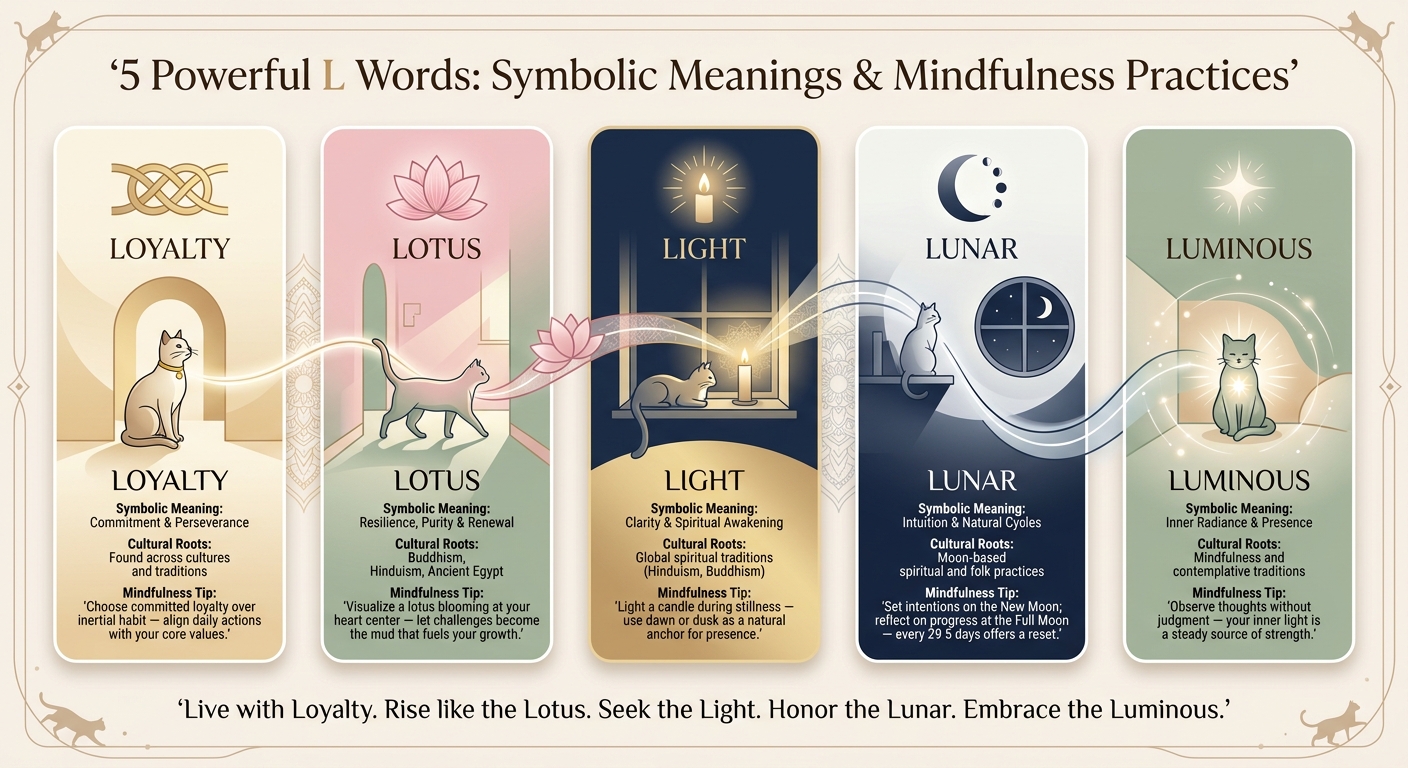
5 Powerful 'L' Words: Symbolic Meanings & Mindfulness Practices
Language has a way of shaping how we see the world. Some words carry layers of meaning that go beyond their definitions - they touch something deeper, something felt rather than simply understood. Among these are five 'L' words: loyalty, lotus, light, lunar, and luminous. Each one connects to a different aspect of human experience: commitment, resilience, clarity, rhythm, and radiance. Let’s take a closer look at how these words resonate across cultures and traditions.
What makes these words stand out is their universal resonance across time and place. Take the lotus, for example. This flower appears in Buddhist, Hindu, and ancient Egyptian traditions, each culture finding its own meaning in its beauty. In Buddhism, the lotus represents purity and the ability to rise above negativity, much like the Buddha himself. Hinduism links the lotus to the goddesses Lakshmi and Vishnu, as well as to the body's chakras - energy centers often envisioned as lotuses, each with a specific number of petals. In ancient Egypt, the lotus symbolized the sun's daily journey, opening with the light of day and closing at night.
"Lotus flowers often symbolize purity, rebirth, and inner strength. They remind us to search for beauty even when life seems ugly." - Jason Zuk, Psychic Medium
The moon, or the lunar element, carries similar significance across cultures. Its steady cycles have long symbolized intuition, renewal, and the rhythm of life itself - birth, growth, rest, and rebirth. Many spiritual practices are tied to the phases of the moon, reflecting its quiet wisdom. Unlike the rush of modern life, the moon’s consistency reminds us to honor life’s natural rhythms, embracing each phase as part of a greater whole.
Light and luminous take us inward, speaking to moments of clarity and presence. Light has always been a symbol of awakening, the instant when confusion clears and understanding emerges. The word luminous adds a sense of warmth and radiance, as if this light isn’t just external but something we feel within. Both words connect to mindfulness practices that value inner clarity and being fully present. And then there’s loyalty, a word often associated with relationships but just as powerful when applied inwardly. Loyalty can mean staying true to our own values, even when it’s challenging.
| 'L' Word | Symbolic Meaning | Cultural or Spiritual Roots |
|---|---|---|
| Loyalty | Commitment and perseverance | Found across cultures and traditions |
| Lotus | Resilience, purity, and renewal | Buddhism, Hinduism, Ancient Egypt |
| Light | Clarity and spiritual awakening | Global spiritual traditions |
| Lunar | Intuition and natural cycles | Moon-based spiritual and folk practices |
| Luminous | Inner radiance and presence | Mindfulness and contemplative traditions |
These words invite us to reflect on how their meanings can shape our daily lives. Whether it’s finding clarity, honoring natural rhythms, or staying true to what matters, they remind us to live with intention and connection.
sbb-itb-b6c1dc0
Incorporating 'L' Words Into Mindful Practices
Grasping the meaning of a word is one thing, but weaving it into your daily life is where the true transformation lies. These 'L' words serve as anchors, offering stability when life feels chaotic. Let’s explore how each one can shape your mindfulness practice in practical ways.
Take loyalty, for example. E.B. Johnson reminds us: "It's hard to maintain a stable and loving partnership without a strong element of mindfulness running throughout." This idea doesn’t just apply to relationships with others - it begins with yourself. Being loyal to your values and beliefs, even when it’s uncomfortable, is a profound act of self-awareness. In relationships, loyalty means showing up fully, both physically and emotionally, and staying present even in challenging moments.
The lotus offers a powerful symbol for resilience and growth. Think of life's challenges as the "mud" that the lotus needs to thrive. A simple lotus visualization can help you embrace this mindset: find a quiet space, close your eyes, and imagine a closed lotus bud at your heart. With each breath, see its petals gradually opening, releasing a soft, warm light. This practice shifts your focus from the struggle itself to the growth and beauty that can emerge from it.
"If you feel lost, disappointed, hesitant, or weak, return to yourself, to who you are here and now, and when you get there you will discover yourself, like a lotus flower in full bloom, even in a muddy pond, beautiful and strong." - Masaru Emoto
Light and luminous are reminders to seek clarity and presence in everyday moments. A quiet morning, a heartfelt conversation, or a moment of ease can feel like a luminous pause, offering space for mindfulness. Viktor Frankl’s logotherapy introduces the concept of dereflection, which encourages shifting focus from what’s wrong to what’s meaningful. When faced with a challenge, try asking yourself: "What would life look like without this problem?" This subtle shift can rekindle your inner light and bring a sense of calm.
Lastly, the lunar cycle offers a natural rhythm for self-reflection and alignment. The new moon invites you to set intentions, while the full moon encourages reflection on what has come to fruition. You don’t need elaborate rituals - a simple journal entry during each phase can deepen your connection to yourself. The crescent moon, often linked to intuition during times of transition, provides an opportunity to pause and ask: "Where am I being guided, and why?"
These practices remind us that mindfulness isn’t about grand gestures but about finding meaning and presence in the small, steady rhythms of life.
1. Loyalty
Loyalty as an active practice - more than a passive feeling
Loyalty isn’t something that simply exists; it’s a daily, intentional choice that shapes how we live and interact with the world.
Author Gordon R. Clarke expresses this beautifully:
"Spiritual loyalty is a conscientious and trustworthy living of the spiritual facts of being. It is not enough merely to be acquainted with the truth. One must be actively loyal to it."
This perspective encourages us to move beyond automatic routines and embrace a deeper, more thoughtful kind of commitment - one that is guided by our values and principles.
It’s helpful to think of loyalty in two forms. Inertial loyalty is sticking with something purely out of habit, while committed loyalty is a conscious decision to align your actions with what matters most to you. The distinction is important: one keeps you in place, while the other propels you toward growth.
So, take a moment to reflect - do your daily choices truly reflect your values? Loyalty is not just what you feel; it’s what you do. By practicing this active form of loyalty, we cultivate the same mindfulness and intention that resonates through these 'L' words.
2. Lotus
The lotus as a symbol of rising above difficulty
The lotus flower offers a striking metaphor for resilience and transformation. Despite growing in murky, muddy water, its petals emerge pristine and untouched. This contrast has made the lotus a timeless symbol in Buddhism, Hinduism, and ancient Egyptian culture, representing the human ability to rise above difficult circumstances without being defined by them.
"If you feel lost, disappointed, hesitant, or weak, return to yourself... and when you get there you will discover yourself, like a lotus flower in full bloom, even in a muddy pond, beautiful and strong." - Masaru Emoto
One aspect that deepens the lotus’ significance is its daily cycle. Each night, the flower closes, only to reopen fresh with the morning light. This natural rhythm serves as a gentle reminder: darkness and hardship are temporary, and every new day brings an opportunity for renewal. It’s a powerful idea to weave into mindfulness practices, encouraging us to embrace the present moment and start anew.
A simple practice inspired by this is heart-centered visualization. Imagine a lotus bud at the center of your chest, slowly blooming with every breath, radiating warmth and light outward. This technique, rooted in yogic traditions, can help cultivate feelings of compassion and inner peace.
The "lotus effect" - a natural property of the flower's surface that repels water and dirt - also offers a mental parallel. When negativity or challenges arise, picture them sliding off like water on a lotus leaf, leaving your focus and inner calm intact. Just as loyalty requires active commitment, the lotus teaches us to face adversity with quiet strength and grace.
This theme of renewal and resilience sets the stage for exploring more mindfulness practices in the sections to come.
3. Light
Light as a daily anchor for presence
Light serves as a grounding force in our daily lives, a symbol that connects us to deeper truths. Across various traditions, from Hinduism to Buddhism, light embodies clarity, wisdom, and the dispelling of ignorance. In Hindu belief, light represents Brahman - the ultimate reality - and acts as a force that eradicates darkness, both literal and metaphorical. Similarly, in Buddhist teachings, the soul's journey is often described as moving away from suffering and toward the illuminating wisdom of light. It’s a physical phenomenon, yet its presence resonates with profound meaning.
The moments of dawn and dusk hold a quiet power. These natural transitions invite us to pause and reflect.
"At twilight, when light and darkness merge, our consciousness gradually brightens - a subtle mirror of our spiritual journey." - Rachel Weissman
Watching the soft changes in light during sunrise can naturally anchor you in the present moment. It offers a gentle, unstructured way to practice mindfulness, often more accessible than formal meditation.
One simple way to connect with light is by lighting a candle during a moment of stillness. The flickering flame becomes a point of focus, a small yet meaningful symbol of the light of truth within. This act signals to your mind that this time is intentional - a brief retreat from the day’s distractions. Engaging with light in this way can also deepen your awareness of other natural rhythms, like the phases of the moon, reminding us of the interconnected cycles that shape our world.
4. Lunar
The moon as a natural rhythm for self-awareness
The moon, with its steady phases, offers a unique rhythm to encourage moments of reflection and self-discovery.
Every 29.5 days, the moon completes its cycle, creating 12 natural opportunities each year to pause, reassess, and realign with what’s meaningful. These phases serve as gentle reminders to slow down and check in with yourself.
Each stage of the lunar cycle carries its own purpose. The New Moon marks a time to set intentions - quietly planting seeds for what you hope to grow. The Full Moon, on the other hand, is a moment to reflect on progress, celebrating what’s been achieved or adjusting where needed. As the moon waxes, energy rises, fueling new efforts. When it wanes, it signals a time to release what no longer serves you.
This rhythm mirrors the natural ebb and flow of energy and motivation in life, encouraging acceptance rather than resistance to these shifts.
Try this: on the next New Moon, write down one specific intention. When the Full Moon arrives, revisit it and note any changes or progress. These lunar resets can help you align your values with your daily actions, nurturing mindfulness and self-awareness along the way.
"If it can move entire oceans, imagine what it can do for your intentions." - Luminos Path
5. Luminous
Your inner light as a steady source of strength
In our journey through the 'L' words, the idea of luminous energy represents the culmination of inner strength and mindfulness. It reflects that quiet yet unwavering light within us that persists, even in the face of hardship.
"There is a light within each one of us, the light of purity, truth, and strength." - The Luminous Lotus
This inner light, tied to self-awareness, fosters a steady confidence that comes from truly knowing yourself, rather than seeking approval from the outside world.
A simple way to connect with this idea is through a three-step daily mantra shared by Buddha Groove:
"Led by the light within, I rise through every challenge and find my way back to center."
Each part of this mantra - recognizing the light within, rising above challenges, and returning to a place of calm - offers a grounding ritual that helps restore balance and peace.
The concept of luminosity also encourages you to take on the role of an observer in your own life. By noticing your thoughts and reactions without rushing to judge them, you create a small but powerful shift in perspective. This practice can help you feel more present and centered in your daily life. Embracing your inner light strengthens mindfulness and builds on the resilience and clarity explored earlier.
Conclusion
The five 'L' words - loyalty, lotus, light, lunar, and luminous - offer more than just poetic appeal. Together, they weave a meaningful framework for approaching life with greater intention, awareness, and presence.
What makes these ideas resonate so deeply is how seamlessly they interconnect. The lotus, for instance, emerges from mud into light, echoing the soul’s journey toward growth and clarity. The lunar cycle reminds us of the balance between effort and rest, while luminosity reflects an inner glow revealed by staying true to ourselves. Loyalty ties it all together, grounding us in our values and personal path.
"Mindful Living, one could say, is the art of truly being alive." - Kavita Maharaj, Author, Red Door Yoga
The beauty of these concepts lies in their simplicity. You don’t need to rearrange your entire life to feel their impact. Small, thoughtful actions - like adding lotus imagery to your space, taking a few quiet moments each morning, or wearing a symbol that speaks to you - can shift your perspective. Mindful living thrives in these everyday choices, where intention transforms the ordinary into something meaningful.
Ultimately, how you connect with these words is entirely personal. Let them serve as gentle reminders, not rigid expectations - nudges toward the resilience, clarity, and light that already exist within you, waiting to unfold.
FAQs
How can I practice loyalty to myself without feeling selfish?
Practicing loyalty to yourself involves nurturing self-awareness and showing yourself compassion through steady, everyday actions. Take time each day for moments of self-reflection, caring for your needs, and reinforcing positive thoughts about yourself. Shift your focus toward kindness instead of guilt - it’s a mindset that not only supports your personal well-being but also enhances your connections with others. Understanding this practice as essential rather than indulgent can help you embrace it fully.
What does the lotus symbolize in different cultures?
The lotus is often seen as a symbol of purity, spiritual awakening, and renewal in various traditions. In Hinduism and Buddhism, it is closely tied to enlightenment and divine beauty, frequently shown alongside deities in sacred art. In ancient Egyptian beliefs, the lotus was a reminder of rebirth and the cyclical nature of life. Meanwhile, in Chinese traditions, it conveys harmony and the ability to rise above earthly concerns. Across cultures, the lotus beautifully represents the journey of spiritual growth and overcoming challenges to reach enlightenment.
How can I use the moon’s phases for a simple journaling routine?
Aligning your journaling practice with the moon’s phases can bring a sense of rhythm and intention to your reflections. During the new moon, focus on setting goals or planting the seeds of new ideas. As the moon moves through its waxing phases, take time to reflect on the progress you’re making and the steps you’re taking to grow. The full moon is an ideal moment to celebrate milestones, acknowledge your achievements, and express gratitude. Finally, during the waning phases, use your journal to explore what no longer serves you and consider what you’re ready to release.
Whether you write daily or weekly, this practice encourages mindfulness and self-awareness, helping you stay in tune with both your inner world and the natural cycles around you.


Dejar un comentario