

Selling digital art has never been easier or more accessible. With platforms designed to connect artists and buyers directly, you can showcase your work, manage sales, and even automate marketing tasks - all from one place. Whether you're offering digital files, print-on-demand products, or licensing designs for merchandise, the right app can help you reach a global audience while keeping more of your earnings.
Here’s a quick look at some of the best platforms:
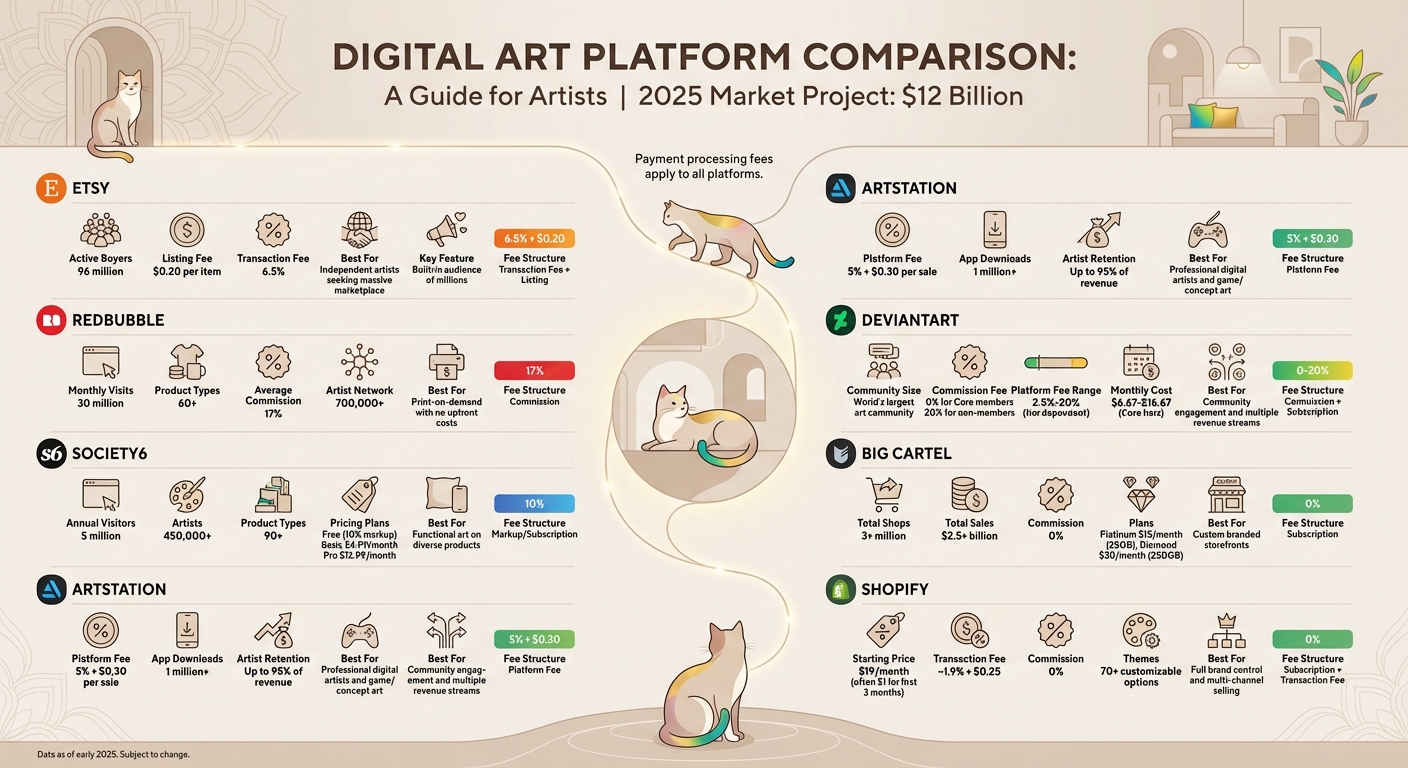
- Etsy: A massive marketplace with 96 million active buyers, ideal for independent artists. Listing fees are $0.20 per item, with a 6.5% transaction fee.
- Redbubble: A print-on-demand platform offering over 60 product types and flexible pricing. Artists typically earn 17% commission per sale.
- Society6: Focused on functional art, with options to feature designs on 90+ products. Monthly plans start at $4.99, allowing customizable markups.
- ArtStation: Tailored for professional digital artists, offering a combined portfolio and marketplace with low fees (5% + $0.30 per sale).
- DeviantArt: The largest art community, featuring subscription-based selling options and promotional tools like "Boosts."
- Big Cartel: Perfect for those wanting a personalized storefront with no commission fees. Paid plans start at $15/month.
- Shopify: A robust e-commerce platform offering full control over branding and customer relationships, starting at $19/month.
Each platform has its strengths, from built-in audiences to customizable storefronts. Choosing the right one depends on your goals - whether it’s maximizing exposure, retaining earnings, or managing your brand independently. Below, we’ll explore each app in detail to help you decide which fits your needs best.
Digital Art Platform Comparison: Fees, Reach, and Features
Why Selling Digital Art Online Changes Everything
The move from traditional galleries to digital platforms has completely reshaped how artists approach their careers. It’s not just about switching venues - it’s a reimagining of the entire process, from creating to selling.
One of the most noticeable shifts is financial. Traditional galleries often take a hefty commission, sometimes as much as 50% of an artwork’s value. In contrast, digital platforms have disrupted this model by offering much lower commission rates, allowing artists to keep more of their earnings.
Geography is no longer a barrier, either. Digital platforms have opened up access to global audiences, connecting artists with buyers far beyond their local communities. For example, one artist shared how their reach expanded dramatically through online sales, tapping into markets they never thought possible. With thousands of creators showcasing their work on these platforms, the opportunities for exposure are immense.
Another advantage is the ability to scale without the need for physical inventory. Print-on-demand services let artists offer their designs on various products - like posters, clothing, or home goods - without worrying about production or shipping. For many, this has led to significant increases in revenue, especially when combined with the built-in audiences and sales tools provided by these platforms.
Perhaps the most empowering change is the direct connection to buyers. Artists no longer have to rely on gallery owners to set prices or manage sales. Instead, they can take control of their branding, pricing, and customer relationships. This direct-to-consumer approach also gives them access to valuable customer data, enabling real-time experimentation with new designs or pricing strategies.
Digital platforms come equipped with tools for branding, pricing, and audience engagement, helping artists seize new market opportunities. With the digital art market expected to approach $12 billion by 2025, these platforms have leveled the playing field, making it possible for artists - regardless of their background or location - to thrive in ways that traditional galleries couldn’t offer.
sbb-itb-b6c1dc0
What to Look for When Choosing a Digital Art Selling App
Picking the right platform for selling your digital art boils down to five key factors: audience reach, fee structure, interface design, customization options, and marketing tools. Each of these plays a role in determining how visible your work is and how much profit you can retain. Let’s take a closer look at what each of these means for you as a digital artist.
Fee structures are a critical consideration because they directly impact your earnings. Platforms handle fees differently - some charge a fee per listing and a transaction fee, while others offer subscription plans that eliminate per-sale fees but still require you to cover payment processing costs. For instance, some platforms have transaction fees as low as 1.5%, which is much lower than the typical 3–4% charged by many others. To decide what works best for you, calculate your break-even point. If you sell a high volume of work, a subscription-based model might save you more in the long run compared to paying per sale.
Audience reach is another major factor. Some platforms come with an established audience, giving your work immediate visibility. However, this often means competing with a large number of other artists. Alternatively, self-hosted platforms put the responsibility of driving traffic on you, typically through social media or advertising. The upside? You have full control over the buying experience and can build direct relationships with your customers.
Customization and marketing tools are what help you stand out in a crowded marketplace. Features like email marketing tools, analytics dashboards that track your sales, and visual aids - such as room visualizers that let buyers see your art in a home setting - can make a big difference. Additionally, platforms that incorporate AI to recommend your work to collectors can boost your visibility. Payment flexibility is another detail to consider; offering options like Apple Pay or Google Pay can simplify the checkout process, making it easier for buyers to complete their purchases.
With consumers spending over $2.5 trillion annually on digital goods, selecting a platform that balances audience reach, fair fees, and effective marketing tools is essential to turning your art into a reliable source of income.
1. Etsy
User Base and Reach
Etsy boasts an impressive 96 million active buyers as of 2026, making it the go-to marketplace for independent artists and creators. This vast audience provides a prime opportunity to showcase your digital art to a wide range of potential customers. With 9 million active sellers, however, standing out through strategic presentation becomes crucial.
Ease of Integration and Setup
Setting up your Etsy shop involves five key steps:
- Pick a memorable and brand-friendly shop name
- Write a welcoming shop announcement
- Craft an engaging "About" section to share your story
- Define clear shop policies
- Activate Etsy Payments for seamless transactions
Etsy’s mobile app makes managing your shop straightforward - you can update listings, handle customer inquiries, and monitor activity all from your phone. Each listing allows up to 10 images and 13 tags, so make the most of these features. For your primary image, consider using a room scene mockup to help buyers visualize your art in their spaces, which can lead to better conversions.
Commission Fees and Pricing Structure
Etsy’s fee structure includes a $0.20 listing fee per item (valid for four months or until the item sells) and a 6.5% transaction fee on each sale. To price your items effectively, factor in all costs with this formula: (Print cost + materials + labor) × 2.5 markup + Etsy fees. Keep in mind that payment processing fees vary by country and apply to the total sale amount, including shipping. For those just starting, allocating $1–$3 per day to Etsy Ads can help generate early traction. Additionally, Etsy’s built-in marketing tools can amplify your shop’s visibility.
Marketing and Promotion Tools
To succeed on Etsy, treat your shop like a professional storefront. Optimize your titles by placing high-intent keywords at the beginning - Etsy search results show about the first 40 characters. Structure your titles like this: Style > Subject > Medium > Size > Target Room. Use all 13 tags available, focusing on phrases buyers are likely to search for, such as "blue wall art bedroom", instead of overly technical terms. Tools like Marmalead ($19/month) and eRank (starting at $5.99/month) can refine your SEO strategy.
Building trust and social proof is equally important. Include handwritten thank-you notes with your orders and follow up with customers 7–10 days after delivery to encourage five-star reviews. Those first 20 reviews can significantly impact your shop’s success, so prioritize excellent customer experiences from the start.
2. Redbubble
User Base and Reach
Redbubble has carved out a space for artists to share their work with a global audience, offering tools that make it easier to sell art digitally. The platform connects you to a network of over 700,000 independent artists and attracts more than 30 million visits per month. Most visitors come from countries like the US, UK, Canada, and Germany. With Redbubble, you can apply your designs to over 60 product types, ranging from stickers and apparel to home decor, all through a print-on-demand system.
To gain visibility on the platform, upload at least five designs and enable at least one product per design. Redbubble offers three account tiers: Standard, Premium, and Pro. While the Standard tier comes with monthly fees deducted from your earnings, the Premium and Pro tiers include advanced marketing tools and account management features. You can also link your social media accounts to help customers connect with your brand beyond the marketplace.
Commission Fees and Pricing Structure
Redbubble's pricing system starts with a base price for each product, covering manufacturing and platform costs. Artists then set their own markup percentage, which determines the royalty they earn. On average, artists receive about 17% commission per sale, though many choose to set higher markups - such as 40% for T-shirts or 50% for stickers - to increase their earnings.
For Standard tier users, monthly fees are deducted from earnings, with a maximum cap of $97 for those with higher sales. Premium and Pro accounts, however, are free from these fees. Payouts are made monthly, provided you meet the minimum threshold of $20.
Marketing and Promotion Tools
Redbubble’s platform is optimized for search, so using the right strategies can greatly improve your shop’s visibility. Take advantage of all 50 available tags and include 1–2 relevant keywords in your titles to make your designs easier to find. To stand out, focus on niches with low-to-medium competition, such as pet-themed artwork or distinctive aesthetics. Because internal search results can be highly competitive, driving external traffic to your shop - through platforms like Pinterest and Instagram - can make a big difference in boosting visibility and sales. These steps can help you make the most of Redbubble’s tools and reach a broader audience.
3. Society6
User Base and Reach
Society6 offers a space where art meets functionality, connecting creators with a large audience while providing a variety of product options. With around 5 million annual visitors and a network of over 450,000 independent artists, the platform thrives on its print-on-demand model. This means you can focus on uploading your designs while Society6 takes care of production, packaging, and shipping. Your artwork can be featured on more than 90 product types, including wall art, home decor, furniture, and lifestyle items, allowing you to cater to a broad range of customer tastes.
To ensure your designs look their best, upload high-resolution files (at least 6,500×6,500 pixels at 150 ppi, though 300 ppi is ideal). The platform creates mock-ups automatically, but it’s important to review them manually to ensure your designs are displayed as intended. Having at least five distinct designs in your store not only boosts credibility but also gives visitors more options to explore.
Commission Fees and Pricing Structure
Society6 offers different pricing plans to suit various creative goals. For those just starting, the free plan allows up to 10 designs with a fixed 10% markup, though this percentage can feel limiting. If you’re looking for more flexibility, the Basic plan costs $4.99/month and supports up to 100 designs, with the ability to set your own markup (10%–999%) for art prints and canvas prints. For more serious sellers, the Pro plan at $12.99/month accommodates up to 10,000 designs and includes additional tools like an analytics dashboard, trend reports, and webinars.
Keep in mind that Society6 deducts a shipping fee ranging from $0.30 to $8 per item, depending on the product. Payments are processed monthly through PayPal once you reach a $20 minimum threshold. Any unpaid amounts roll over to the next payout cycle. During setup, you’ll need to verify your PayPal account with a $1 transaction.
Marketing and Promotion Tools
Society6 provides useful tools to help you promote your designs effectively. A public Promo Schedule allows you to align your marketing efforts with site-wide sales and events. To enhance visibility, optimize your product titles, tags, and descriptions for both internal and external searches. You can also link your social media profiles, such as Instagram and Pinterest, in your artist bio to expand your reach and connect with potential customers.
For Pro plan users, access to trend reports offers valuable insights into what’s currently popular, helping you tailor your designs to market demands. This feature, combined with regular engagement and thoughtful promotion, can significantly boost your exposure and lead to more consistent revenue over time.
4. ArtStation
User Base and Reach
ArtStation stands out as a platform tailored for professional digital artists, offering both a polished portfolio and a marketplace in one place. With millions of weekly visitors and over 1 million app downloads on Google Play, it provides a significant opportunity for exposure. What sets ArtStation apart is its ability to combine a professional portfolio with a marketplace store. As artist Nicolas Swijngedau describes it, this creates a "double impact", seamlessly connecting your work with potential buyers.
The platform also fosters a strong sense of community, which encourages ongoing engagement. Followers are automatically notified of new releases, helping artists maintain an active audience. Many creators take advantage of this by offering free downloads, or "Freebies", to attract more followers. With over 5,000 free downloads happening daily, the community-driven aspect of ArtStation supports both visibility and sales growth.
Ease of Integration and Setup
Getting started on ArtStation is straightforward. You can sign up using Epic Games or Google, and from there, upload your first product with descriptions and tags. There are no upfront listing fees, making it risk-free to begin selling. Tyler Smith, Senior Environment Artist at Sucker Punch, highlighted how the platform's user-friendly interface and analytics tools helped him turn portfolio views into actual sales with minimal effort.
ArtStation also simplifies the technical side of online selling. Features like automated cart recovery emails and wishlist campaigns help convert casual visitors into buyers. Sales, payments, and customer messages are all managed through a centralized system, which is especially efficient when accessed via the desktop version.
Commission Fees and Pricing Structure
ArtStation offers a competitive fee structure that allows artists to retain the majority of their earnings. The platform charges a 5% fee plus $0.30 per sale. If a buyer is directed to your product through ArtStation's internal promotions, an additional 3% is deducted. However, by using the Seller Affiliate Program to promote your own work, you can recover that 3%, enabling you to keep up to 95% of your revenue.
This model has allowed ArtStation to distribute millions of dollars to artists worldwide. Payouts are flexible, with options for weekly, monthly, or threshold-based transfers via bank or PayPal.
Marketing and Promotion Tools
ArtStation includes built-in marketing tools to help artists turn interest into sales. The platform's coupon creator generates professional-looking promotional images for easy sharing across social media. Additionally, ArtStation organizes global sales events, prominently featuring participating products on its Marketplace homepage.
The affiliate system offers another way to expand your reach. Beyond promoting your own products through the Seller Affiliate Program, you can enable Community Affiliates, allowing others to earn 3% for recommending your work. Freelance Concept Artist Antoine Collignon appreciates this streamlined approach:
"I can just start selling without worrying about the promotion and audience targeting. With other competing marketplaces, you definitely have to promote yourself. Here, I can just focus on the product itself."
5. DeviantArt
User Base and Reach
DeviantArt stands out as the world's largest art community, giving digital artists access to an expansive audience. This sheer scale provides unmatched visibility, which is a major advantage over smaller or newer platforms. Artists can turn this exposure into income through various avenues like Subscriptions, Premium Downloads, Commissions, and Exclusives.
One notable tool is the "Boost" system, which amplifies the reach of your artwork across the platform. Depending on their membership tier, Core members receive between 1 and 5 free boosts per month, allowing them to strategically promote their best work. Additionally, artists can use "Gems" to award "Hype" and "Core" badges to others, fostering networking and increasing their presence within the community. This broad reach makes DeviantArt an appealing choice for artists seeking both visibility and integration.
Ease of Integration and Setup
DeviantArt simplifies the onboarding process with automated tools that make it easy to set up shop. The Exclusives feature streamlines the process of listing, promoting, and managing earnings.
Your profile comes with a "Shop" tab where your work is displayed, along with a "Top Supporters" section to showcase buyer engagement and build trust. For private transactions, you can use Sta.sh, DeviantArt's private storage, to sell art directly through messaging without needing to post publicly. Interestingly, in 2024, 98% of the top sellers using Exclusives offered multiple product types rather than sticking to just one, highlighting the platform's adaptability. With these tools, artists have access to an efficient and flexible setup process.
Commission Fees and Pricing Structure
DeviantArt's fee structure depends on your membership level. Non-members pay a 20% fee on commissions and premium downloads, but Core members enjoy zero commission fees across all tiers. For subscriptions and downloads, platform fees start at 20% for non-members and drop to 2.5% for Core Pro members.
| Plan | Monthly Cost (Billed Annually) | Platform Fees | Commission Fees | Monthly Boosts |
|---|---|---|---|---|
| Non-Member | Free | 20% | 20% | 0 |
| Core | $6.67 | 12% | 0% | 1 |
| Core+ | $8.33 | 5% | 0% | 2 |
| Core Pro | $12.50 | 2.5% | 0% | 3 |
| Core Pro+ | $16.67 | 2.5% | 0% | 5 |
Higher Core tiers also increase the maximum selling price for your work, ranging from $100 for non-members to $15,000 for Core Pro+ members. Artists can even enable a 10% resale royalty on Exclusives, earning passive income when their work is resold. These pricing options, combined with promotional tools, offer artists a comprehensive way to grow their earnings.
Marketing and Promotion Tools
DeviantArt complements its straightforward setup and competitive fees with robust marketing features. The Early Access option allows supporters to purchase new art 48 hours before it becomes publicly available, creating a sense of exclusivity and urgency. Artist @GihhBloonde shared:
"Early Access gives my community a chance to grab items early, creating a sense of excitement and exclusivity that adds extra value to both the experience and adoptable."
Exclusives are automatically included in the DeviantArt Shop and highlighted through promotional banners on your profile. Members at the Core Pro and Pro+ levels gain access to Advanced Analytics, enabling them to track performance and refine their strategies to boost engagement. Additional tools include the ability to gift up to 20 exclusives per month to reward loyal fans and scheduling features to maintain a consistent presence without daily uploads. These resources make it easier for artists to connect with their audience and maximize their visibility.
6. Big Cartel
User Base and Reach
Big Cartel supports over 3 million shops globally, contributing to more than $2.5 billion in sales. With over 6 million products listed, it provides digital artists a platform to showcase their work in a space that aligns with their creative identity. Its focus on artists ensures that your storefront feels like an extension of your artistic vision.
Ease of Integration and Setup
Big Cartel makes it simple for digital artists to set up an online shop that mirrors their creativity. The process involves just four steps: selecting a template, adding products, configuring store details, and publishing. No technical expertise, coding, or plugins are needed, making it accessible for anyone, even first-time sellers. The platform also supports digital delivery, offering customers instant download links after purchase. Files up to 1GB can be uploaded directly, while larger files can be shared through external links like Google Drive or Dropbox. As one seller, Anarres Metal, shared:
What I love about selling my work through Big Cartel is how easy each step, from designing my store front to listing products and managing orders, has been and continues to be.
Commission Fees and Pricing Structure
Big Cartel stands out with its 0% commission policy, ensuring you keep all your earnings aside from standard payment processing fees (2.9% + $0.30 per transaction). However, digital product features are available only on paid plans. The Platinum plan, priced at $15/month, includes 25GB of storage and allows 1 file per product. For $30/month, the Diamond plan offers 250GB of storage and supports up to 5 files per product. This straightforward pricing ensures artists can focus on selling without worrying about hidden costs.
Marketing and Promotion Tools
Big Cartel provides tools to help you expand your reach and promote your art effectively. It integrates seamlessly with platforms like Instagram, Facebook, and Google Shopping, allowing you to connect with a broader audience. Features like discount codes and scheduled product drops make it easier to plan strategic releases. The Diamond plan also includes abandoned cart recovery, helping you recover potential lost sales. Additionally, the mobile app lets you manage your shop on the go - whether it’s adding products, tracking inventory, or handling in-person sales at markets or galleries. As Hog Island Press notes:
Big Cartel's customer service is professional and kind.
7. Shopify
User Base and Reach
Shopify offers digital artists a unique platform by allowing them to sell their work across multiple channels, including their own websites, social media, and even physical locations through its integrated POS app. Unlike traditional marketplaces where competition for visibility can be intense, Shopify gives you control over your customer relationships and data. This setup empowers artists to build stronger connections with their buyers. One standout feature is Shop Pay, known for its streamlined, one-tap checkout process, which helps reduce cart abandonment and improves sales conversions. With Shopify's integrated shipping tools, artists can easily reach collectors around the world while retaining full control over their brand and presentation.
Ease of Integration and Setup
Starting a Shopify store is straightforward and doesn’t require any coding skills. The platform offers over 70 customizable, mobile-friendly themes, making it easy to create a professional-looking storefront. For digital artists, the free Digital Downloads app simplifies file delivery by automating the process. Files like JPEGs, PDFs, and ZIPs (up to 5GB) can be attached directly to products, with instant download links sent to customers after purchase. Artists who want to branch out into physical merchandise can use print-on-demand integrations, eliminating the need to manage inventory. Artist Maria Qamar (Hatecopy) shared how automation changed her workflow:
At some point the volume became so much that I couldn't make time to draw. I was spending all of my days delivering and in transit... Now I can focus on actually creating art.
Commission Fees and Pricing Structure
Shopify uses a subscription model rather than taking a percentage of your sales, which can be more cost-effective as your business grows. The Basic plan starts at about $19 per month, with introductory offers often reducing it to $1 per month for the first three months. Online credit card fees are approximately 1.9% plus $0.25 per transaction. This approach ensures that, aside from standard payment processing fees, your earnings remain your own - unlike platforms that charge commissions on every sale.
Marketing and Promotion Tools
Shopify equips artists with tools to boost visibility and promote their work effectively. Built-in SEO features, monthly email credits, and AI-powered tools for generating product descriptions and marketing copy are just some of the resources available. New users can also access Google Ads credits to kickstart advertising campaigns. Additionally, Shopify’s App Store offers over 6,000 third-party apps, enabling features like customer reviews and advanced marketing automation. For artists dealing in digital collectibles, apps like Verisart (rated 4.7/5) allow you to mint NFTs and issue Certificates of Authenticity, helping to establish trust with buyers. Ken Harman, a gallerist at Spoke Art, highlights the importance of presentation in online sales:
If you have a bad image of your work or the image doesn't represent the work accurately, you're going to have a harder time selling it.
How to Get More Visibility on Digital Art Platforms
Expanding the reach of your digital art involves more than just choosing the right platform - it’s about using thoughtful strategies to boost visibility. Start by crafting product descriptions that focus on the keywords potential buyers are searching for. Instead of a vague title like "Blue Watercolor Print", opt for something more descriptive and targeted, such as "Serene Ocean Waves Watercolor – Coastal Wall Art for Modern Homes." This approach not only appeals to search engines but also speaks directly to buyers looking for specific styles or themes. Since over 60% of online shoppers browse on mobile devices and tend to skim content, leading with the most important details is crucial.
Bring your descriptions to life by including sensory details that evoke emotion. Instead of just listing technical features, describe the mood or feeling your art creates. For example, phrases like "vivid blue waves" or "the refreshing zest of summer" can help potential buyers imagine the piece in their space. Highlight the benefits alongside the features - for instance, instead of simply noting "archival paper", explain that it "ensures vibrant colors that last for decades." Use short paragraphs to tell a story about your art and bullet points for quick, scannable details like dimensions and materials.
Social media platforms like Instagram and Pinterest can be powerful tools for driving traffic to your work. Instagram Shops let you tag products directly in posts and stories, making it easy for followers to explore and purchase your art. Pinterest, functioning as a visual search engine, offers long-term visibility by connecting your work to users searching for similar aesthetics. Using realistic room mockups can also make a big impact - showing your art in a styled living space helps buyers visualize how it might look in their own homes, which often leads to higher engagement.
Beyond social media, take advantage of platform-specific tools to improve discoverability. Many digital art platforms now use AI-powered features to match your work with potential buyers based on their preferences. Optimize your image filenames and alt text with relevant keywords, as these play a role in how search engines find your work. Regularly reviewing analytics can also help you refine your keyword strategy, ensuring it’s based on data rather than guesswork.
Finally, don’t underestimate the value of building relationships. Engage with other artists, reply to comments, and use email newsletters to stay connected with your audience. Integrated messaging tools can help you nurture relationships with buyers, while consistent branding across product descriptions and social media builds trust. Over time, this combination of connection and strategy can lead to more sales and a stronger presence in the digital art world.
Conclusion
Selecting the right app can make a significant difference in turning your digital art into a thriving creative business. The key lies in matching the platform's features with your artistic and financial priorities - whether your focus is generating consistent income through print-on-demand services or connecting with serious collectors who value premium digital pieces.
To get started, consider what matters most to you: maintaining control over your brand, minimizing transaction fees (some platforms charge as little as 1.5%, well below the standard 3–4%), or leveraging automated marketing tools that can handle up to 80% of your promotional efforts. Many platforms provide free trials or "free to start" options, allowing you to explore their features and usability before committing to a subscription.
The digital art market is growing quickly, with over $50 million in combined artist earnings already circulating through modern platforms. As Kerstin Gold, an Art Market Strategy Advisor, explains:
"Our future will undoubtedly see a shift in ownership preferences... seamless solutions invite galleries, artists, and collectors to become involved in this transformative journey."
Now is the perfect time to establish your presence. Use the strategies discussed earlier to boost your digital art sales and connect with your audience. The tools are ready, collectors are actively searching for fresh work, and your art deserves to be seen. Take the steps to turn your creative passion into a sustainable and rewarding business.
FAQs
Which app is best for beginners selling digital downloads?
Big Cartel is a great option for beginners looking to sell digital downloads. It provides a straightforward setup, handles automatic delivery of digital files, and removes the hassle of relying on third-party plugins or additional subscriptions. This simplicity makes it an ideal platform for artists who are just starting their journey.
How do I choose between subscription fees and per-sale fees?
When deciding between subscription fees and per-sale fees, it helps to think about your sales patterns and long-term goals. A subscription fee involves a fixed monthly or yearly charge, making it a good choice for businesses with consistent sales. It provides predictable expenses and can lead to better profit margins over time. On the other hand, per-sale fees are charged with each transaction, which works well for businesses with irregular sales since it minimizes upfront costs. Consider how often you expect to make sales to determine which option aligns best with your business needs.
What should I do to get more visibility without paid ads?
To increase visibility without relying on paid ads, lean into organic strategies. Share your art on visually-driven platforms like Instagram, TikTok, and Pinterest, where creativity thrives. Consistency is key - post regularly, interact with your followers, and include relevant hashtags to widen your reach.
Additionally, build a polished portfolio on professional sites to present your work effectively and connect with potential buyers. Getting involved in art communities or participating in creative challenges can also help you gain exposure while fostering trust and connections over time.


Leave a comment