

Cats move through life with a quiet confidence, navigating spaces and moments without the boundaries we so often impose on ourselves. While we divide our homes into rigid zones and our minds into structured compartments, cats see their world as one seamless whole. They slip through tight spaces, rest wherever they please, and respond to their surroundings with calm precision. This fluid way of being isn’t just about their physical abilities - it reflects a mindset that values presence over control.
Their heightened senses - whiskers that detect subtle air shifts, eyes that thrive in low light, and ears that pinpoint faint sounds - help them engage deeply with their environment. But beyond their anatomy, cats remind us of something deeper: the power of living fully in the moment. Unlike humans, who often resist change or overthink, cats meet life with ease, adapting to challenges without hesitation.
How Cats Navigate Space with Natural Ease
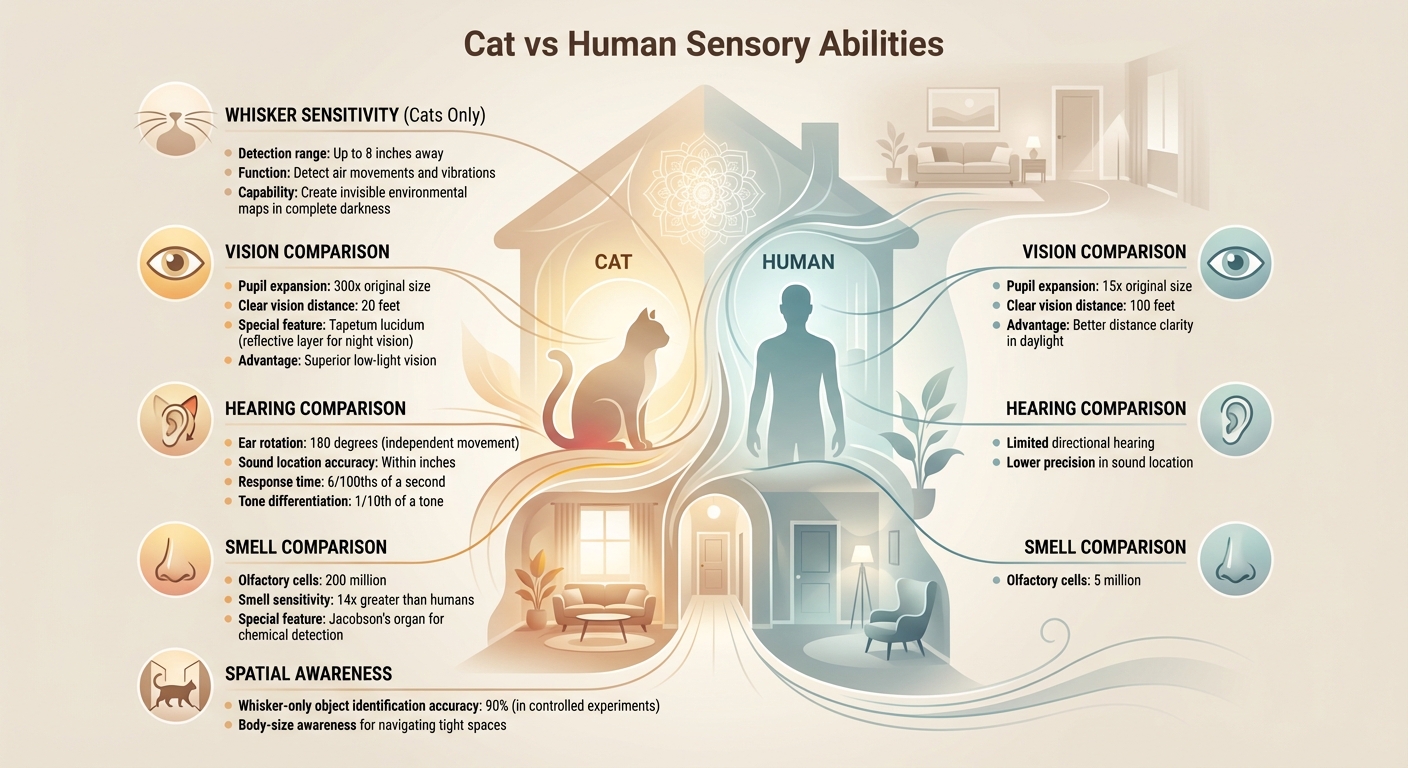
Cat vs Human Sensory Abilities: A Comparative Analysis
Instinct and Sensory Awareness in Cats
Cats have an incredible ability to interpret their surroundings, relying on a complex sensory system that works seamlessly. Their whiskers, known as vibrissae, function as sensitive tools, detecting even the slightest air movements. This allows them to sense objects up to 8 inches away, creating a kind of invisible map of their environment. These whiskers are so finely tuned that they can pick up tiny shifts in air pressure and high-frequency vibrations, enabling cats to "see" their surroundings even in complete darkness.
Their eyes, on the other hand, are built for low light rather than sharp detail. Humans may see distant objects more clearly, but cats have a visual advantage in dim conditions. Thanks to a reflective layer called the tapetum lucidum behind their retinas, light is bounced back through their eyes, enhancing their night vision. Their pupils can expand to an astonishing 300 times their original size, compared to just 15 times for humans. While a human might see clearly at 100 feet, a cat would only see the same clarity at 20 feet. But when the lights go out, cats move effortlessly, while we’re left stumbling.
Hearing and smell add even more depth to their perception. A cat's ears can rotate independently, swiveling 180 degrees to locate sounds with pinpoint accuracy - within inches and in just six-hundredths of a second. Their sense of smell is equally impressive, with up to 200 million olfactory cells compared to our modest 5 million. This allows them to build an invisible map of scents, detecting differences in sound as small as one-tenth of a tone and smells with a sensitivity 14 times greater than ours.
Together, these heightened senses don’t just help cats move - they shape how they perceive and interact with their space, creating a world that’s rich with texture and depth far beyond what humans can experience.
Territory as a Fluid Concept
This extraordinary sensory perception influences how cats view their territory. For us, walls and doors are fixed boundaries, but for cats, space is far more fluid and dynamic. Their keen awareness of their own body size lets them approach tight spaces with confidence, calculating whether they can squeeze through with remarkable precision.
"Cats demonstrate body-size awareness when faced with spatial challenges, such as squeezing through tight openings." - Web Desk, Madhyamam Online
For cats, territory isn't just about physical barriers; it's defined by scent. They leave invisible markers that fade over time, creating a constantly shifting map of their domain. Using the Jacobson's organ, located above the roof of their mouth, cats perform the Flehmen response - a behavior that allows them to "taste" the air. This helps them gather detailed chemical information about who or what has been in the area and when.
Unlike humans, who structure time and space around rigid schedules and walls, cats align their sense of territory with natural rhythms. Their internal clocks are guided by the cycles of dawn and dusk, making their perception of space feel more organic and less confined. In controlled experiments, cats have shown an impressive 90% accuracy in identifying objects using only their whiskers, proving that their understanding of boundaries doesn’t rely on sight alone. Their world is a blend of instinct, sensory input, and adaptability, making their navigation of space both precise and fascinating.
sbb-itb-b6c1dc0
Why Humans Divide Their Spaces
While cats move effortlessly through their surroundings, we humans tend to carve up our environments into distinct zones. Our homes reflect this tendency: the kitchen serves for cooking, the bedroom for sleeping, and the office for working. But these physical separations are just the beginning. On a deeper level, we segment our lives mentally, organizing them into neat compartments to maintain a sense of order and control.
This urge to divide is rooted in our desire to manage our surroundings. By deciding when to welcome the outside world and when to shut it out, we create a sense of security. Our homes, with their walls, doors, and fences, are physical expressions of this need for control. Yet, while we enforce boundaries to create order, cats show us another way. They share spaces with ease, adapting to different times and needs without conflict. This difference highlights how our need for control can sometimes limit our ability to live fully in the moment, unlike the natural flow cats seem to embrace.
Mental Barriers in Daily Life
The boundaries we create aren’t just about physical spaces - they’re also about protecting our emotional and mental well-being. Marissa Moore, a Registered Associate Marriage and Family Therapist, explains:
Personal boundaries help us state what is and isn't acceptable to us. Setting boundaries has various benefits for promoting overall mental health and well-being.
Without these mental boundaries, life can feel overwhelming. When work and personal time blur together, for example, we risk burnout - a state of exhaustion caused by chronic stress. To avoid this, we draw lines in our minds: work stays at the office, family time happens at home, and hobbies get their own space. These divisions help us maintain what psychologists call a "healthy balance of independence and interdependence." They ensure we don’t feel drained, resentful, or disconnected from our own needs.
However, while mental boundaries protect us, they can also come with a downside. They may shield us so effectively that we lose touch with the richness of life unfolding around us.
How Fixed Boundaries Reduce Presence
Rigid boundaries, while helpful in some ways, can also distance us from the present moment. When we focus too much on justifying our actions or sticking to predefined roles, we risk becoming disconnected from the simple act of being. The constant noise of a structured life can drown out the quieter, more meaningful experiences.
These fixed divisions insulate us, allowing us to concentrate on specific tasks but also narrowing our awareness. We might miss out on the subtle details - the way sunlight dances through a window, the texture of a favorite chair, or even the quiet rhythm of our breathing. Cats, on the other hand, don’t claim spaces as exclusively theirs. They move fluidly, sharing and adapting to their environment without resistance. By creating overly compartmentalized lives, we risk losing the ability to engage with the world as it is. Unlike cats, whose movements are guided by instinct and presence, our self-imposed boundaries can make life feel less vibrant and connected.
Learning Mindfulness from Cat Behavior
Cats have an incredible way of existing purely in the present. While we often find ourselves caught between endless tasks or replaying past events, a cat lives entirely in the here and now. This isn’t about laziness or simplicity - it’s a kind of mindfulness that we, as humans, have made more complicated for ourselves. Leo Huang, quoting a cat breeder, once noted that cats seem to say, "I'm here now and everything is great, so just be happy." This mindset - free from the burdens of a "verbally remembered past" or a "verbally imagined future" - offers us a powerful reminder to reclaim presence in our own lives. By observing this natural way of being, we can start to see how mindfulness might look in practice.
Moving with Awareness: Lessons from Cats
Cats don’t rush through life; they approach each moment with intention. Take a moment to watch how a cat navigates a tight space between furniture. It doesn’t charge through recklessly or leave it to chance. Instead, it pauses, carefully assessing the space before moving forward. Studies have shown that cats consciously evaluate their surroundings, taking stock of their physical environment before acting. This deliberate pause serves as a gentle nudge for us to do the same - taking a moment to check in with ourselves before responding to challenges.
Cats also rely on heightened sensory awareness to guide their movements. Every step is informed by their sharp senses, whether it’s the sound of a distant movement or the feel of a surface underfoot. While we may not have their finely tuned instincts, we can still adopt a similar practice. Instead of rushing through your day on autopilot, pause to notice the small things around you: the texture of a countertop, the faint sound of birds outside, or the way sunlight filters through a window. These moments of sensory awareness can anchor us in the present, much like a cat’s focused attention.
Exercises to Release Mental Boundaries
One way to embrace this mindful state is through curiosity. Try stepping outside your usual routines by "walking like a cat." Let your surroundings guide you instead of heading straight to a destination. If something catches your eye - a crack in the sidewalk where a weed grows, the play of shadows on a wall, or a distant sound - stop and explore it fully. This simple shift in perspective can help break the cycle of rushing from one task to the next.
Another practice inspired by cats is the slow blink. Cats use this gesture as a sign of trust and calm - their version of a smile, as writer Rowyn Rose puts it. Interestingly, research shows that when humans mimic this behavior, cats often respond in kind. Beyond connecting with your feline friend, the slow blink can also serve as a calming tool for yourself. Narrow your eyes slightly, hold them half-closed for a moment, and then blink slowly. This small action can interrupt feelings of stress and create a brief moment of peace in your day.
Finally, consider practicing single-minded focus, something cats excel at naturally. When a cat watches a bird through the window, it gives the bird its full attention. When grooming, that’s all it focuses on. In contrast, we often divide our attention - checking our phones during conversations, planning meals while trying to relax, or thinking about work while playing with our pets. Choose one activity and give it your full attention, much like a cat in observation or play. This isn’t about being more productive; it’s about being fully present. As psychologist Steven Hayes explains, "Mindfulness is not meant to be an escape from discomfort, but a way to accept it without judgment." Cats don’t judge their experiences - they simply live them, moment by moment. By adopting these mindful habits, we can begin to move through life with the same fluidity and ease that cats embody.
Cats as Symbols of Freedom and Presence
Drawing from their graceful movements and mindful demeanor, cats have long stood as symbols of freedom in both their behavior and the stories we tell about them.
Cats in History and Culture
For thousands of years, cats have represented something deeply admired by humans: the ability to move through life on their own terms. In Ancient Egypt, cats - known as mau - were held in such high regard that harming one was strictly forbidden. When a family’s cat passed away, they would shave their eyebrows in mourning, a touching sign of how intertwined cats were with daily life. Cats were closely associated with deities like Isis and Bastet, embodying qualities of independence, grace, and protection.
This admiration wasn’t confined to Egypt. In Norse mythology, the goddess Freyja traveled in a chariot pulled by two grey cats, symbolizing both strength and self-reliance. In Russia, cats hold a special place in tradition, being the only animals allowed into Orthodox Christian temples. There’s even a belief that a cat should be the first to enter a new home, ensuring good fortune for its inhabitants. The Hermitage Museum in Saint Petersburg continues a practice dating back to Empress Elizabeth in 1745, maintaining a group of around 74 cats to guard its priceless art from rodents. These cats are lovingly cared for by dedicated staff, underscoring their importance.
In Islamic tradition, cats are also revered. It’s said that the Prophet Muhammad avoided disturbing a sleeping cat, reflecting their respected status. Meanwhile, in Japan, the maneki-neko (beckoning cat) has become a widely recognized symbol of prosperity and good luck. Across these diverse traditions, cats are celebrated for their unique ability to exist freely - effortlessly moving between sacred spaces and everyday life, embodying a kind of independence that humans admire.
How Cats Shape Home Energy
This rich symbolism extends into our daily lives, where cats continue to influence the energy of the spaces they inhabit.
A cat’s quiet presence can subtly shift the atmosphere of a home. Unlike the constant activity or noise that other pets might bring, cats create a sense of calm and balance. Research from Washington State University highlights that cats chosen for animal-assisted programs often share traits with therapy dogs, such as sociability and a willingness to engage with people. However, as Professor Patricia Pendry notes, they do so on their own terms. "Some individuals may find comfort in a cat's quiet presence rather than the enthusiastic energy of a dog", she explains.
This blend of independence and connection is what makes cats such compelling companions. They don’t demand attention, yet they offer it freely when they choose. They move through our homes with an awareness we often overlook - pausing to observe, basking in sunlight we didn’t notice, or curling up in forgotten corners. By simply being, they remind us that presence isn’t about constant action; it’s about fully inhabiting the moment. In their quiet way, cats encourage us to slow down, notice the small things, and appreciate the spaces we share with them. Their presence brings a sense of balance, grounding us in the here and now.
Conclusion: Moving Through Life Like a Cat
Cats don’t get caught up in overthinking. They don’t linger on past mistakes or fret about the future. They simply exist - fully immersed in the present, meeting life with a flexibility that lets them navigate tight spaces and unexpected challenges with ease. But this isn’t just about physical agility; it’s a way of being that carries a deeper sense of mindfulness. Their quiet grace holds lessons we can apply to our own lives.
When life throws curveballs - a job loss, a breakup, or a plan falling apart - you can respond in one of two ways: with resistance or with flexibility. Tensing up and bracing for impact often leads to more discomfort, while a softer, more accepting mindset can help you adapt and move forward. Psychologist Steven Hayes describes this as acceptance without judgment - a practice that encourages us to approach challenges with openness rather than resistance. By softening both your body and mind, you can find a way to keep progressing, even when the path feels uncertain.
Take a moment to watch a cat breathe - steady, calm, and deliberate. Try matching your own breath to theirs for a few minutes. Notice how they give their full attention to something as simple as a beam of sunlight or a drifting speck of dust, treating it as though it’s the most important thing in the world. This isn’t about distraction; it’s the opposite of the frantic multitasking that often leaves us feeling scattered. As Sharon Salzberg points out, focusing on one task at a time is a powerful way to quiet anxiety and stay grounded.
The freedom cats embody isn’t about shirking responsibilities. It’s about choosing to be fully present in the moment, rather than feeling weighed down by obligation. Shifting your mindset from "I have to be here" to "I choose to be here" can dissolve mental barriers that make everyday life feel heavy. Like a cat basking in a sunbeam, you can embrace the moment you’re in, instead of longing to be somewhere else.
FAQs
How can I practice “cat-like” mindfulness in daily life?
To bring a touch of “cat-like” mindfulness into your day, start by moving with purpose and awareness. You might try gentle stretches that mirror a cat’s graceful motions, combining them with slow, steady breaths. Pay close attention to your surroundings and how your body feels, doing so without any judgment - just as a cat seems to intuitively tune into its world. By weaving these simple practices into your daily routine, you can nurture a sense of connection with your environment and embrace a more mindful, flowing way of living.
Why do cats treat space and territory so differently than humans?
Cats experience and interact with their surroundings in ways that are distinct from how humans perceive space. While we often divide and organize areas into fixed compartments, cats approach their environment as something fluid and ever-changing. Their sharp senses - keen vision, an acute sense of smell, and a heightened sensitivity to touch - allow them to move effortlessly through their world. For them, space isn’t rigid but instead feels connected and alive. This perspective reflects their natural instincts, balancing curiosity with a need for safety and autonomy.
What does a cat’s slow blink mean, and can it calm me too?
Cats communicate in subtle and meaningful ways, and a slow blink is one of their most heartfelt gestures. When a cat slowly closes and opens its eyes, it’s a sign of trust and a sense of ease in your presence. This small act carries a soothing energy that can even encourage mindfulness in us. Taking a moment to return the gesture not only strengthens your bond but also invites a sense of calm and awareness into your day. It’s a quiet exchange of peace between you and your feline companion.


Dejar un comentario